0

You’ve probably heard of the consideration stage of the buyer’s journey, and we all move through it on a near-daily basis. But have you taken the time to think about the important role it plays in the experience you provide for your customers?

The consideration stage sits in the middle of the buyer’s journey and plays a crucial role in positioning you as a viable option for prospects. It’s the point in their journey where they’ve identified their problem and are ready to explore every potential solution.

In this blog, we’ll explore the consideration stage and the vital role content marketing plays during this period. You can take what you learn to improve your middle of funnel content and position yourself as a strong competitor moving into the decision stage.Have you read our blog about creating effective content for the awareness stage of the buyer’s journey? It provides an overview of the buyer’s journey, buyer personas, and what you need to know about awareness stage content. Check it out!

What is the Consideration Stage?

Prospects enter the consideration stage of the buyer’s journey when they’ve pinpointed a specific problem. In the awareness stage, they realized there was something in their life they wanted to change. Now, they’re ready to learn about all of the possible solutions to solving that problem. Many buyers take the time to review several options in depth before moving on to the decision stage.

It’s important to remember that consideration stage prospects are focused on finding potential solutions, rather than making a purchase. If you want them to seriously consider you as a potential solution, demonstrate empathy by showing them that you understand their problem.

Person typing on laptop

Why is Content Marketing Important In the Consideration Stage?

The best way to demonstrate empathy to prospective customers is through strategic content marketing. Don’t push your brand prematurely or go for the hard sell with invasive, aggressive advertising. Instead, provide educational content that explores all of the potential solutions to their problem. Ultimately, your goal is to make the short list of options they’re considering as they move into the decision stage.

How to Create Effective Consideration Stage Content

You know that your consideration stage content should impartially educate prospects on potential solutions to their problem. But how can you go about creating that content? It all begins with understanding your audience.

Start by thinking through all of the different options your prospects might consider as the solution to their problem. Can they solve it on their own, or do they need outside help? Is the solution sold off-the-shelf, or is it customized to their specific needs? Try to put yourself in their shoes. Which questions are they asking? What are their most pressing concerns? What are their deal breakers?

Identifying the questions that prospects ask themselves in the consideration stage can help you stick out in their minds moving into the decision stage. You’ll be able to create messaging that speaks directly to their concerns and narrow your target audience to qualified leads who can actually use the solution you have to offer.

Questions to Ask Yourself As You Create Consideration Stage Content

It’s important to be thoughtful and deliberate when creating content for the consideration stage of the buyer’s journey. Your goal is to provide prospects with as much detailed information as possible about each of their options. To do so, ask yourself the following questions about your prospects’ problem:

  • Which specific solutions are they researching?
  • How do they go about researching these solutions?
  • How will they decide which solution is right for them?

Answering these questions helps you nurture relationships with qualified prospects who are most likely to buy from you. And research shows companies that excel at lead nurturing generate 50% more sales-ready leads at 33% lower cost. Ultimately, focusing on your prospects’ pain points allows you to subtly position yourself as the best solution moving forward.

What to Avoid When Creating Consideration Stage Content

The most important thing to avoid in the consideration stage is being pushy or salesy. Instead, nurture prospects strategically and consider the long game. Provide them with relevant information at the right time to stay top-of-mind as they move towards the decision stage. Here are a few things to avoid as you create consideration stage content:

  • Producing content that sounds like an infomercial
  • Overselling or underselling your brand
  • Overtly promoting yourself as the best solution
  • Creating content that’s too general to provide value

What Content is Most Effective During the Consideration Stage?

There are a variety of types of content you can leverage to your advantage during the consideration stage. We’ll take a closer look at a few consideration stage content examples below.

Live Webinars / Product Demonstrations

Webinars and product demos provide a valuable opportunity to show prospects how your offerings work and benefit their lives. And because they’re online, webinars are accessible to everyone, not just those who can travel to an in-person seminar.

Downloadable Resources

These include things like Ebooks, original research, how-to guides, tip sheets, templates, checklists, and slideshares. Providing valuable information free of charge not only helps you educate prospects, but presents you as a trustworthy authority that has their best interests in mind.

Videos

Videos can be a concise, visual way to explain your products or services. And in some cases, they’re a more effective way to tell your story than blog posts, articles, or case studies.

Testimonials / Customer Reviews

Testimonials provide valuable social proof from people who have actually used your product or service. And studies show that a whopping 90% of consumers read online reviews before making a purchase. Prospects are more likely to listen to their peers than aggressive marketing pitches, making customer reviews the perfect way to establish trust.

Case Studies

Case studies are a great way to showcase your past successes to prospects. They’ll be able to see exactly how your product or service benefitted a past customer, helping you build credibility. Proving your worth also helps improve your reputation and grow brand awareness within your industry.

Free Trials

If possible, offer qualified prospects a free trial of your product or services. This demonstrates goodwill and positions you as a trustworthy candidate in their search for the solution to their problem.

Ready to create consideration stage content marketing for your business? Our team of content marketing specialists is here to help.

How many times have you checked your email today? If you haven’t checked it at least once since you woke up this morning, you’re in the minority. According to Adobe’s 2019 Email Usage Study, users spend up to five hours a day checking emails. With stats like this, it is clear that our fascination with our inboxes is an ideal target for digital marketers to make use of email automation tactics. 

What is Email Automation?

Email marketing automation combines traditional email marketing efforts with automated technology to streamline processes and provide relevant content to your audience at the right time. Most companies will send out very general content that may or may not interest a particular contact. With email automation, you can send out highly-relevant content to your contacts based on how they interacted with your site.  The best part of email automation is that once you’ve set workflows up, they’ll continue to run. Forget manually sending out emails to each individual contact — now your emails will automatically send out based on the workflow you created.

How Do Email and Marketing Automation Work Together?

Are you surprised that a shirt you were looking at from your favorite online store a few days ago is now showing up in your emails? If you have the willpower, you may have simply ignored these. But wait, a week later you get another email — this time with a coupon for free shipping on your next purchase. This free shipping offer saves you a nice chunk of change, so you decide to make the purchase. Guess what — that online store has incorporated email automation into their existing email strategy using highly-targeted email content based on your shopping behavior.

An Email Automation Workflow in Action

So, let’s backtrack to the purchase we made with our free shipping offer. We’ll break down the steps of an email marketing automation workflow that could’ve led up this purchase:

  1. You signed up for email offers through an email sign-up form on the company’s website.
  2. You browsed the site, added a shirt to your cart, and exited without purchasing.
  3. The company has an email automation workflow set up to automatically send emails out to customers who didn’t complete a purchase.
  4. You received an email with dynamic content. In this case, it was the shirt you added to your cart. Dynamic content in emails allows companies to send out the same email with content that may differ based on the user’s actions.
  5. You haven’t made a purchase yet, so the company also had in their workflow to send a second email out with a free shipping coupon if no purchase was made.
  6. You finally completed your purchase using your free shipping offer, which ends this particular email automation workflow.

This is only one automation that an ecommerce store could have put into place, but the company may have dozens of others running simultaneously. These email workflows are the backbone of any email automation strategy. No matter how simple or complex a workflow is, each one is meant to assist your email marketing team with your business goals.

Benefits of Integrating Automation into Email Marketing

An effective email marketing automation strategy gives marketers the ability to send behavior-based emails to their audience in an efficient manner. From highly targeted emails to lead nurturing, here’s how automated email marketing can improve your existing email strategy.

Increase Engagement with Dynamic Content 

Contacts are more likely to open your emails when they feel the email matches their own interests. You can alter the email content each recipient receives through dynamic content. This content may change based on an individual’s demographics, preferences, and on-site behavior. With a median ROI of 122%, there’s no reason not to incorporate dynamic content into your emails.

We recommend sending custom HTML emails rather than image-based emails when it comes to email automation.

newsletter background

Save Time & Increase Productivity

Automation helps free up resources for your marketing team and can aid in increased productivity. Think about the time you spend on repetitive tasks in a given day. For email marketers, email automation streamlines these processes, so they can focus on other aspects of their jobs. Gone are the days of manual list cleanups and sifting through email contacts.

Nurture Customers 

Whether you have a short or long sales cycle, your business can benefit from the lead nurturing that email automation provides. Automation workflows can move users down the sales funnel, so your brand is always top of mind, regardless of how close they are to purchasing.

Our Top Five Automation Workflows

Here are our top suggestions on automation workflows that are applicable to any business. They cover a variety of areas you should include in your email marketing, such as welcoming new subscribers, site tracking, contact scoring, and re-engagement.

1. New Email Subscribers

Building your email list should be top-of-mind in order to increase your audience reach. A new email subscriber workflow can be as simple as sending an autoresponder thanking users for subscribing. You can also take this opportunity to execute a detailed drip campaign by sending a series of emails you think would be useful to subscribers.

2. Interest-Based Tagging

Audience segmentation is key in email personalization. Interested in seeing how users interact with a specific product or service? You can set up automations to add tags to users when they look at certain pages of your site.  At Tower, we set up automations to add the tag “Interest in IM Services” if contacts have visited one of our internet marketing service pages at least two times. This helps us track our contacts and also gives us the ability to send IM-based emails to these contacts in the future. We’ve repeated this automation with our web and creative services as well.

3. Contact Scoring

These automations track the engagement of users with your site and email content. The higher the score, the more engaged a contact is with your website and email content. We have a specific point value for each scoring method: Subscribe to list – add 25 points Unsubscribe from list – subtract 25 points Email open – add 10 points Link click in email – add 10 points Site visits – 1 point/session

4. Re-Engage Inactive Users

Feel like your open rates are dwindling? Your email list could be the problem. It’s crucial to periodically check if your email subscriber list is actually opening your emails. You don’t want to pay for contacts who aren’t even engaged with your emails. Instead of manually sifting through your list, create an automation workflow that targets unengaged users. Our re-engagement automation workflow unsubscribes users after six months of not opening emails. If you’re an ecommerce store, you might entice contacts to stay subscribed by sending an email with an online offer before unsubscribing them from your list.

5. Manage Email Preferences

Unfortunately, not all contacts are interested in receiving all your marketing communication emails. But you might be able to stop them from fully unsubscribing. Setting up an automation for users to choose the frequency of emails could keep them on your email list without bombarding them.  Give contacts the option to receive emails weekly, monthly, or even quarterly. At Tower, we segment user email preferences based on the email content. For example, users can choose between receiving monthly newsletters, case studies, and company announcements.

Why Invest in Email Automation for Your Business?

Email marketing is growing at an exponential rate and isn’t going away any time soon. It’s time to improve your email marketing and reach your target audience in their inboxes.

Grow Your Business 

Automating your existing email strategy gives you and your employees extra time to focus on areas of your business that need more attention. This additional time might even allow your team to brainstorm other email marketing initiatives that your business hasn’t had a chance to try. 

Webinars are a great example we’ve seen in B2B and have even tried out for our own agency. Hosting webinars allow your company to increase your expertise and authority in the industry.  Incorporating email automation into your webinar promotion can even help you with registration, reminders, and post-webinar follow-ups.

Provide the Right Content at the Right Time

Each individual in your target audience will be at a different stage in the buyer’s journey. While some may be becoming familiar with your brand, others may be ready to purchase a product or request additional information on your services.

With email marketing automation, you can send content that’s relevant to each contact’s situation. Is someone ready to request a consultation? Send out an autoresponder that allows them to choose a time slot to speak with an employee. Did they make a purchase on your website? Send them a confirmation email with their shipping information. The opportunities are endless when it comes to email automation.

Keep Your Brand Top of Mind

Growing a healthy email list allows you to stay in touch with current and potential customers, even if they haven’t visited your site for awhile. Sending out monthly emails keeps your brand on their mind and also keeps them up-to-date on current promotions and updates.

Ready to boost brand awareness and nurture your customer base? Our specialists can help you build your email marketing strategy from scratch or improve your existing processes.

In the fall of 2019, we had a local children’s author, Hillary Daecher, reach out to us seeking help in developing a social media marketing strategy. Hillary had no prior experience of any kind with any social media platforms so we dug in to create a social media strategy from scratch.

This project was Hillary’s first step into the social media world. While I had more experience with social media in general, this was my first time creating a social media strategy. Throughout this process I had to determine what to include in the plan, who to target, which platforms to use, and how to organize it all into simple, actionable steps.

Getting Started With Social Media Strategy

Maybe you are in a similar situation. There are a million different ways you can set up a social media plan and it can seem overwhelming if you’re new to the game. But it’s not as difficult as it seems. As you follow the steps I’ve outlined, you will narrow your focus down to just the essentials. And, you’ll end up with a manageable plan centered around only the most important, relevant information. 

Are you looking to create a social media strategy for someone else or for your business? Or maybe you’re a freelancer / one-man team. If you’re a beginner when it comes to creating social media strategies like I was, then this blog is for you. Trust me, you can do this, too! No prior experience necessary!

What is a Social Media Strategy?

A social media strategy is a marketing plan that is created to successfully utilize relevant social media platforms to reach your goals. Strategies and plans will vary greatly depending on a number of factors:

  • Audience
  • Product / service
  • Industry
  • Budget
  • Competition

Think of social media strategy as a road map. The purpose of the plan is to help you reach your goals (the end-point). The process of creating the strategy is like routing the best path from where you are to where you want to be. It will vary greatly depending on your specific start and end points.

One audience/platform may be right for someone else but not for you. Creating a plan will determine what roads you should take. Just like traveling from point A to point B, it is a linear process. You can’t skip ahead when traveling (unless you’ve figured out teleportation, in which case please fill me in), just like you can’t engage an audience before you build one.

How Do you Create & Implement a Social Media Strategy

There is no one-size-fits-all social media marketing plan. Everyone has a different point A and B. Luckily, there is an abundance of platforms and tools to choose from, each with their own advantages and disadvantages. There are best practices that everyone can follow, but the intricacies of a plan will depend largely on the factors above. I will run through the process we completed for our client as an example of how to create a fully customized social media plan.

Why Create a Social Media Strategy?

Social media marketing has become a necessity to individuals and businesses looking to grow. Social media platforms enable people to connect with massive audiences they wouldn’t be able to otherwise. Social media platforms are tools for businesses, enabling them to reach their goals by targeting their audience by demographics, geography, interests, and more.

Why not create a social media strategy? Social media platforms are largely free! These massive platforms allow you to connect with your audience on a very personal level, in a way you traditionally can’t through other mediums such as: email, organic search, website traffic, or referrals. These mediums are tremendously important, but social media taps into a different type of connection with your audience to complement your overall marketing strategy.

There are a vast amount of platforms to choose from, so there is something for everyone. Seriously! Here are the top 75 social media platforms to know for 2020. There are also many goals that can be accomplished through the use of social media, including:

  • Brand awareness
  • Visibility
  • Website traffic
  • Lead generation
  • Signups
  • Sales
  • Engagement
  • Building a community
  • Promotion of events

First Step: Define Goals

Goals can vary greatly depending on the business / individual. Take some time to write down and solidify your goals as a first step. Gather information, determine what your current position is, where you want to go, what you have to offer, and who you want to serve.

In this case our client desired to:

  • Build brand recognition
  • Increase visibility
  • Build connections
  • Engage her audience
  • Promote visits & book readings
  • Sell books

Who Will Your Social Media Plan Be Focused On?

Once you have your goals clearly defined, you will need to determine who you will be connecting with. Who is your customer? Who are your biggest fans? Who does your product / service serve? If you are unsure, you can start broad and narrow down as you go, adjusting your strategy to the metrics and KPIs (key performance indicators) discussed later in this post.

Second Step: Define Your Audience

Hillary’s soon-to-be published children’s book is about overcoming fears and obstacles. In this case, the audience was:

  • Parents with young children (Pre-K to 2nd grade)
  • Child counselors
  • Child therapists
  • Children’s book authors
  • Independent authors
  • Booksellers
  • Librarians / libraries
  • Child care facilitators / facilities
  • Hummingbird groups / festivals

I determined this audience through an interview my co-workers conducted with Hillary. If you’re developing a plan for someone else, talk to them about who their audience is. Do research. If possible, get the decision-maker involved! Ask them questions. Ask who they serve, who is the product/service made for? Here is a list of questions to ask your client or yourself to define your audience!

Data Sources for Defining Your Audience

Other tools to gather data about your audience include Google Analytics and the Census (if you’re in the United States). Using these resources will help you gather demographic and geographic data, and learn about interests and behaviors. Here is a useful guide to using Google Analytics audience data. Don’t guess who your audience is, use the data available to you.

Once you have your target audience narrowed down, use your gathered information to create a persona. A persona is a fictional character you create to represent your target audience. Learn how to create a persona here. Next, you will determine where your audience is!

What Social Media Platforms to Use?

Third Step: Choose Your Platforms

There are a vast number of different social media platforms to choose from, so it’s important to determine which platforms are the most relevant to your business, and focus on them first. Ideally you only start with a few to avoid becoming overwhelmed, unless you hire a social media marketing team to manage the workload.

Some of the largest social media platforms include:

  • Facebook
  • Instagram
  • LinkedIn
  • Youtube
  • Twitter
  • Pinterest

Do industry-specific research to find any other smaller, niche social media platforms relevant to your business. In Hillary’s case, Facebook, Instagram, and Goodreads were determined to be the most important platforms to begin with:

  • Facebook has the largest user platform and is one of the most widely-used platforms in terms of demographics. This would be used for information-based content.
  • Instagram was chosen to use as a visual / moment-based platform, focusing more on photos and videos regarding Hillary’s book and process.
  • Goodreads was chosen to reach her niche audience. Goodreads is a great social media platform for authors to network with readers and book lovers.

Do some research on your industry and the different types of platforms out there to determine what social media platform to use. Hootsuite does a great job categorizing channels into 10 different types of social media platforms.

If you want to learn more about LinkedIn advertising, our guide to LinkedIn ads goes over everything you need to run a successful campaign.

When Should You Be Active on Social Media?

Social media marketing is an ongoing process that requires frequent posts and engagement. This can vary by industry but a general rule of thumb is to post at least once a day. Inactivity has been shown to decrease visibility, leading to less engagement, which leads to even less visibility.

While posts should be frequent, it is important that it’s not a bombardment of posts trying to sell people on things. People are not on social media to be sold to. People trust people, not businesses. As a business, you’ll want to be personable, interact with people, and focus on building relationships and community.

The number of posts should be frequent regardless of industry, but how frequent can be determined by some basic competitor research. The audience for certain industries is more / less active than other audiences. Take some time to look into the activity of the industry leaders and the community and match the activity levels.

Implementation

There are certain best practices we will recommend in implementing your plan, like useful tools that can schedule posts if you have windows of time to work on your strategy. Another option is hiring social media specialists to manage your accounts. The time of day matters for posts as well. Experiment and see what works best for your audience, but here is some data on the best times to post on social media.

Scheduling

There are scheduling features built into some platforms (e.g: Facebook) but others may not have these capabilities. You likely don’t have the time to constantly be working on the social media strategy, so scheduling can help you make the best use of the time you have available.

Set aside a few hours and create a social media calendar. Decide what useful, helpful, relevant content you’re going to create and share, and plan when it will be shared. Third-party tools like Hootsuite, SocialOomph, and SEMrush can help you automate deployment. Here is a list of some more of the top social media scheduling tools.

Combine your research on the industry, your competitors, your audience, and the best times to post. Then set up a strategic schedule using these resources!

How to Organize Your Social Media Plan

Fourth Step: Organize Your Plan

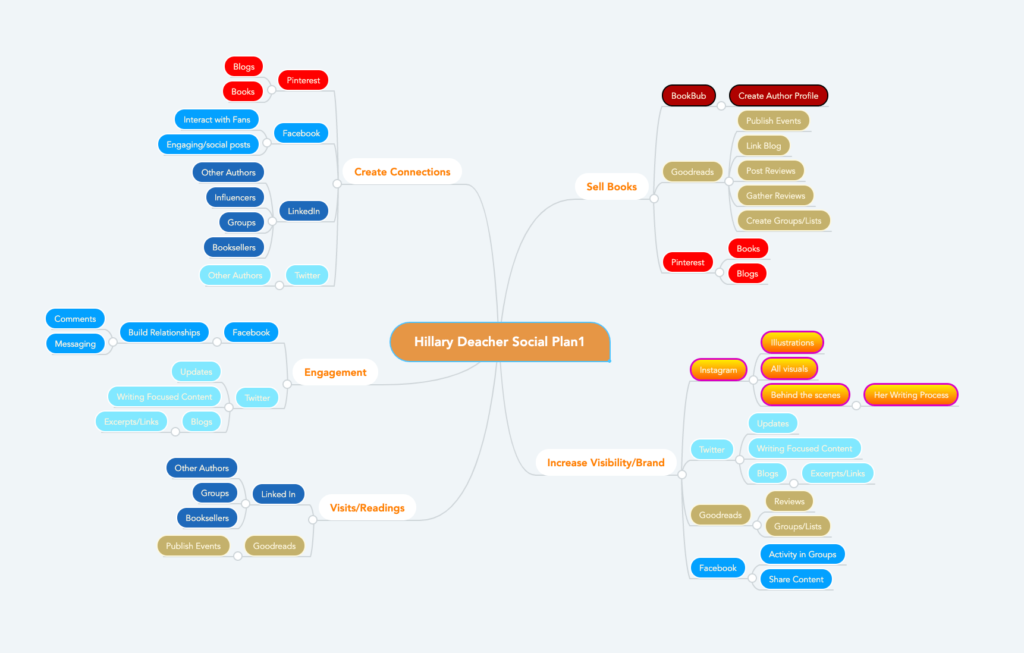
As you do your research to determine your goals, audience, and platforms, write everything down! Write out all your thoughts and potential plans. It’s okay to be messy at first. We can clean it up later! I recommend creating a mind map.

Early notes from Hillary's social strategy.

This is the first draft of the mind map I made for Hillary.

Start from the center, and branch out with the goals you determined. Match potential platforms with the goals they can serve, and then extend the audience you can serve from those platforms. This practice can help visualize how things will work together, and how the system operates as a whole.

Once you start to narrow things down, you can organize your data using the mind mapping tool, Mindmeister. Here you can see I broke down the plan into five goals, and six potential platforms with ideas of what purposes they can serve.

First draft of Hillary's social plan

But six platforms is a lot to handle, especially for one person! So we took this information and narrowed it down even further. We selected the three most vital platforms for her to get off the ground. Once we had our goals, audience, and platforms defined, it was time to break down our goals into steps and phases.

A later version of the social media plan.

Each goal is now numbered in succession. Think about the logical process that needs to occur in order for your goals to work. Each phase is an ongoing process and will take time to develop.

Phase One

Since our client was starting from scratch first we needed to increase her visibility and her brand. This became phase one. We can not create connections, engage, acquire visit opportunities, or sell books without having visibility. This phase included reaching out to groups, inviting contacts to like her pages, creating content, and building out her platforms.

Phase Two

Once we increase visibility and brand awareness, we will be able to create connections. This includes cultivating relationships in groups, posting in discussions, leaving reviews, participating in Q & As, and connecting with new people within Hillary’s circles. This must be done before focusing on engagement.

Phase Three

Once visibility has grown, and connections have been established, the next goal is to engage with your community! Just like any social act, you are looking to cultivate these relationships. Post relevant content that your community will be interested in. Share content, ask questions, and have conversations!

Phase Four

The fourth phase is based around finding and promoting book readings and visits down the road. Having built connections with her audience, she may be able to find new opportunities for events and increase attendance to scheduled events.

Phase Five

The fifth and final phase is based around selling her books. A lot of people make the mistake of trying to set up shop on social media solely to sell things. This misses the point completely. Social media is about community and connection with others, not, “look at me! Buy my stuff.”

Obviously, as a business, you will have a service / product you would like to sell, but the main purpose is to cultivate relationships. If you build successful relationships, you will be able to provide a product / service that aligns with your customers needs and wants, and they will happily support you.

Basic Principles for ANY Person on ANY Platform

  • SOCIAL media is a SOCIAL act. Engage with your community!
  • Post high-quality content.
  • Post frequently.
  • Engage with followers.
  • Be authentic.
  • Ask questions.
  • Include visuals when possible.
  • Know your audience and write to them.

How to Know If It’s Successful

Track it to hack it! Fortunately, most platforms provide a lot of data regarding the performance of your account. The specific metrics you will want to focus on will vary depending on your goals, but there are plenty of commonly tracked metrics across industries/goals.

Some metrics to track for organic (non-paid) efforts:

  • Engagement
  • Reach
  • Impressions
  • Referral traffic to your website
  • Likes / followers
  • Comments
  • Ratings / reviews

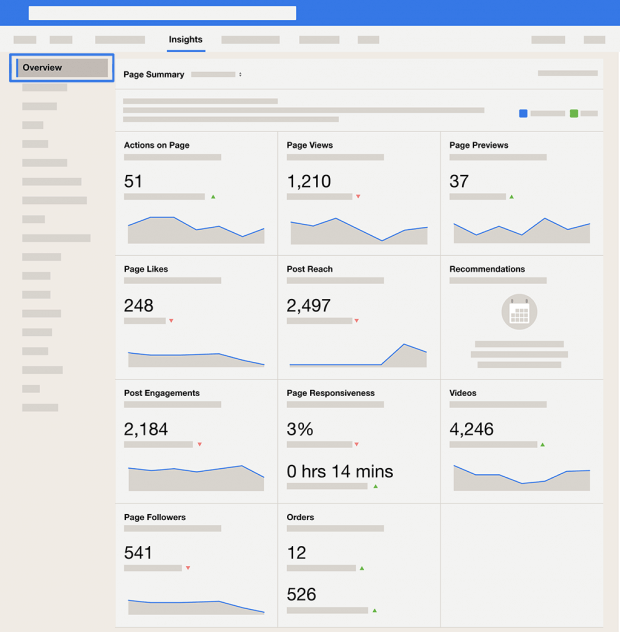
For example, the Facebook Insights tab hosts the majority of these metrics all in one place! Keep an eye on the metrics listed above. Experiment. Make notes of what changes you make and see what affects these metrics for the better or worse.

facebook insights example 1 How to Create a Social Media Strategy From Scratch

Some metrics to track for ads / paid efforts:

  • Click-through-rate (CTR)
  • Cost-per-click (CPC)
  • Cost-per-action (CPA)
  • Conversions
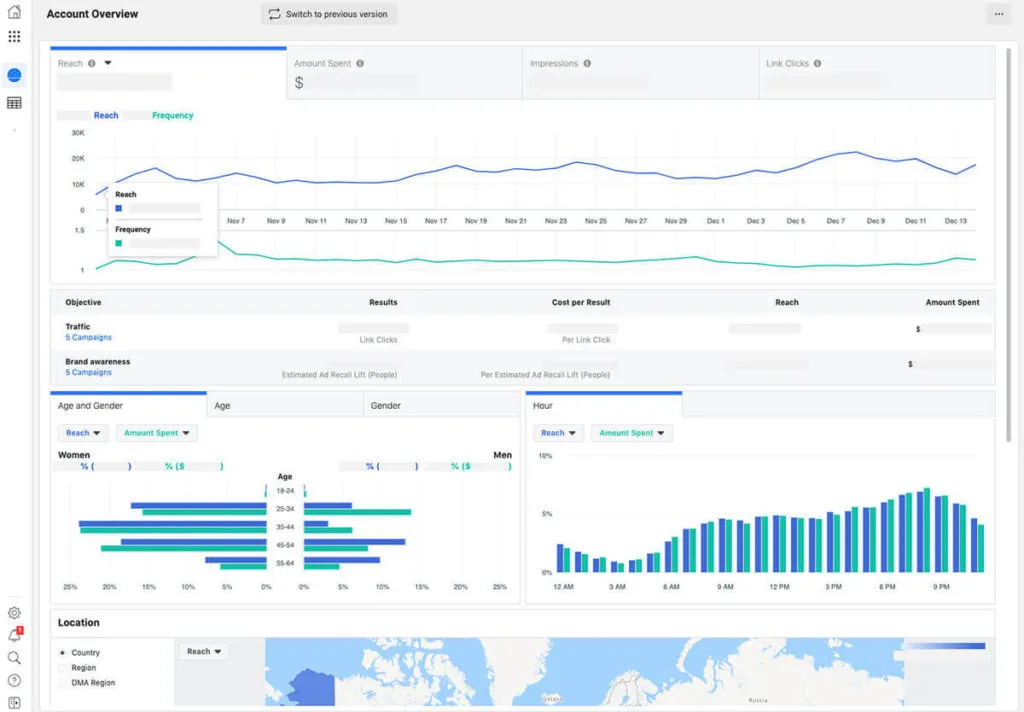
  • Ad frequency

Facebook provides all of this data and more. The most important thing to do is to use the data you have available to you. Watch for changes in these metrics and take advantage of these insights!

Data from social advertising

Social advertising is a beast in itself, but can be a very effective and cost-efficient way to increase your reach and leads.

Resources

Different platforms work best with different image sizes. Use this always-up-to-date guide to social media image sizes to ensure your content is optimized for the selected channel.

If you need content ideas, browse Google Trends or Exploding Topics.

Another way to utilize social media is by optimizing your website for social media.

Some of the software we use to run and create social media strategies includes Google Analytics, SEMrush, and Facebook Ads. Google Analytics is an incredibly powerful tool for determining who your audience is. Here is a guide on how to use Google Analytics to evaluate your audience.

So What’s Next?

Building out this social media strategy, I learned a lot of valuable information and found the whole process rewarding. Hillary followed the plan and has seen a lot of success come from it, and I couldn’t have been happier to hear that. Creating this strategy and this road map kept us accountable and on track, and served as an actionable guide to reach the goals we set.

I know this can be difficult and I know it’s a lot! But I promise you it’s worth the effort. Time to create your social media strategy. Please feel free to reach out to me on LinkedIn and ask for help or to share your story. I’d love to hear from you! Building and implementing a social media strategy can be time-consuming but it can also be very rewarding. Human beings are social creatures, we thrive on communicating with others and that is how social media has become such a huge part of our lives.

If you’re looking to build your brand, engage your audience, and reach potential customers, it’s time to embrace the tools available to you. Our specialists can help you get more out of your social media efforts.

Have you ever used direct mail marketing for your business? In the digital age, many marketers avoid direct mail because they think it’s old-fashioned and can’t compete with other channels. Other companies have used direct mail before, but weren’t happy with their ROI because their campaign wasn’t well executed.

If you’ve ever asked “what is direct mail marketing?” or want to learn more about this time-tested marketing channel, we’re here to help. This ultimate guide provides the basics you need to understand direct mail marketing. We’ve also sprinkled in tips and advice that will help you execute your next campaign like a pro.

What Is Direct Mail Marketing?

Before we can get into the details, it’s important to define direct mail and direct mail marketing. Let’s start by answering a common question :: what is direct mail?

Direct mail is print marketing that’s sent out in the mail (usually via the USPS). It can come in a variety of formats, such as postcards, brochures, and parcels. Direct mail can contain coupons and offers, or it can be purely informational with a soft call to action (CTA). Direct mail is sent to a predefined group of people on a mailing list or carrier route (a smaller segment of a ZIP Code).

Direct mail marketing is a form of direct marketing that targets people with direct mail pieces sent in the mail. Like any marketing channel, it has its own set of best practices. We’ll take a closer look at two of them below.

Direct Mail Best Practice :: The 40 / 40 / 20 Rule

When it comes to direct marketing, the 40 / 40 / 20 Rule is one of the oldest plays in the book. This guideline was developed in the 1960s by marketing pioneer Ed Mayer. Basically, the 40 / 40 / 20 Rule provides advice on how marketers should break down their direct marketing efforts.

While the 40 / 40 / 20 Rule was created in the pre-Internet age, it’s still relevant today — especially for direct mail marketing. The 40 / 40 / 20 Rule breaks successful direct marketing down into three main elements :: audience, offer, and everything else.

  1. Audience. You should focus 40% of your attention on choosing the right audience for your direct mail piece. Even if your mail piece is perfectly designed, your efforts will be wasted if you send it to people who aren’t interested or can’t use your offer.
  2. Offer. Mayer recommends putting 40% of your energy into creating a relevant offer. Providing recipients with an appealing offer they can actually use encourages them to take action. Including a CTA with your offer is very helpful because your audience knows their next steps.
  3. Everything else. Dedicate the final 20% of your time and energy to the details. This includes elements like direct mail format, design, and copy.

Direct Mail Best Practice :: Reach vs. Frequency

Balancing reach with frequency is also critical to any direct mail marketing strategy. Here’s what we mean by reach and frequency:

  • Reach is the number of people you send your direct mail piece to. In other words, it’s the number of people on your mailing list or carrier route. If you mail to 2,500 people, your reach for that campaign is 2,500.
  • Frequency is the number of times you send your direct mail piece to the same person. If the same person sees your ad two times, the frequency for that campaign is two.

It’s easy to fall into the trap of thinking reach is more important than frequency. You want to get in front of as many people as possible, right? Not necessarily! According to the Rule of Seven, people must see your brand at least seven times before they notice it and take action. That’s a lot of impressions!

With this in mind, you should always prioritize frequency over reach when sending direct mail. Mail to a smaller group of people several times, instead of a large group of people one time. Like any marketing channel, consistency is key to your success because it helps you stay top of mind.

Can Direct Mail Marketing Work for My Business?

Direct Mail scaled What is Direct Mail Marketing?: An Ultimate Guide

Yes! Direct mail works for businesses and organizations in every industry you can think of. Here’s a short list of businesses and organizations that can benefit from direct mail:

  • Restaurants
  • Gyms
  • Grocery Stores
  • Churches
  • HVAC Companies
  • Landscaping Companies
  • Accounting / Tax Firms
  • Automotive Shops
  • Dentists
  • Salons

Whether you’re looking to boost sales, increase brand awareness, or reactivate lapsed customers, direct mail can do it all.

Not convinced yet? Just check out these direct mail response rates from the Compu-Mail. The response rate to direct mail can be as high as 37%. Direct mail also pairs well with digital marketing. And Merkle reports that campaigns using both direct mail and digital marketing saw a 118% lift in response rates, as opposed to campaigns that only use one advertising channel.

Who Should I Send My Direct Mail To?

Figuring out who to target with your direct mail is the first step of any successful campaign. Who you mail to varies based on the goals of your direct mail campaign, which we’ll discuss later. First, let’s look at three common methods marketers use to segment their direct mail audience.

Ways to Segment Your Direct Mail Audience

There are a variety of ways to segment your audience into groups with shared characteristics. Here are three of the most common:

  • Geographic segmentation. This method is exactly what it sounds like and involves targeting people within a specific geographic area. This might be people who live within a specific ZIP Code, carrier route, or radius of your business.
  • Demographic segmentation. This method breaks people down into groups that share specific personal characteristics. These can include gender, race, income, education, and employment.
  • Firmographic segmentation. This method is used in business-to-business (B2B) marketing. It breaks companies into groups based on traits like industry, location, customer type, legal status, and performance.

Putting Audience Segmentation Into Action

So, what does audience segmentation look like when it comes to direct mail marketing? Here are a few examples:

  • New mover campaigns. These help you drum up business with people who are new to your area. You can purchase a mailing list of new movers and get to them before the competition.
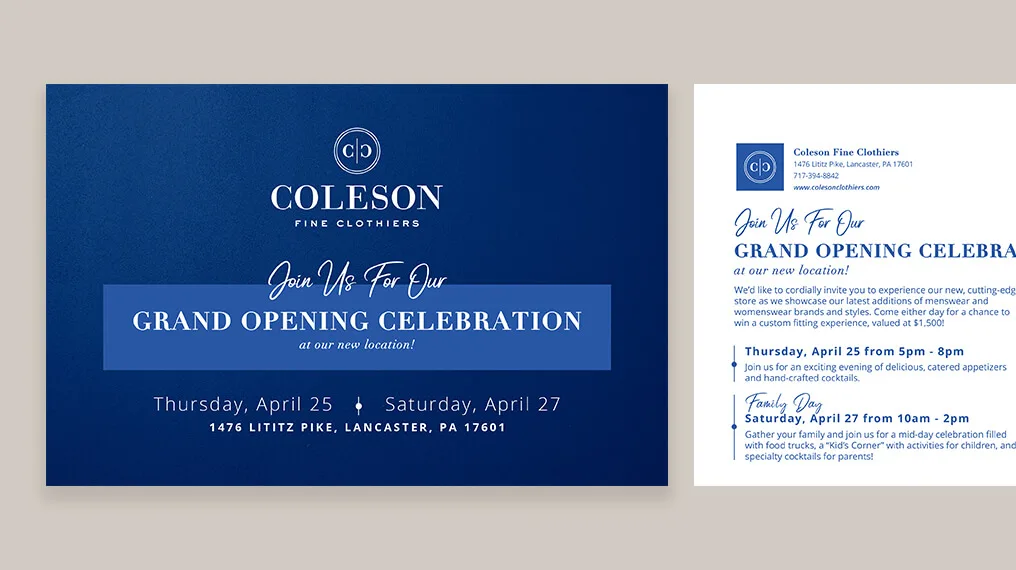
  • Grand opening campaigns. Opening a new location? Use geographic segmentation to target people who live within a certain area of your new location.
  • Abandoned cart campaigns. Use your eCommerce platform to identify people who have abandoned their online shopping cart. Mailing them a special offer for the product / service they were interested in can get them to complete their transaction. Abandoned cart remarketing is commonly done via email, but direct mail is also a great option because most companies don’t use it for this purpose.
  • Birthday campaigns. Obtain a list of prospects with birthdays or mail to your existing customer database during their birthday month. Making this personal connection can encourage them to take action on your CTA.
  • Rewards club / loyalty program campaigns. Show appreciation for members of your rewards club or loyalty program by sending them special offers. This is a great way to upsell, since they’re already brand advocates.
  • Upsell campaigns. Send existing customers an offer for an item that complements something they recently bought from you. For example, if someone purchases bait from your sporting goods store, send them an offer for a fishing rod. Even if they aren’t in the market for a rod at the moment, they’ll be reminded of your brand and may purchase from you again in the future.
  • Winback campaigns. Since you already have data on lapsed customers, it’s easy and inexpensive to create a personalized offer they’re likely to respond to.

What Are Direct Mail Formats?

So, you know who to mail to and the campaign type that’s best for you. But which direct mail format should you choose? This is a very important decision, and the format you choose can have a big influence on whether your campaign is successful. Here are a handful of the most common direct mail formats.

Brochures / Menus

Brochures have more space than some other direct mail formats, so they’re perfect for sharing detailed information about your products / services. If you run a foodservice business, your brochure might take the form of a menu. Menus help boost brand exposure because recipients may put them on the fridge or in a kitchen drawer.

Letters

Because they’re sealed in an envelope, letters can feel more confidential than other formats. They also offer a lot of personalization options. They’re great for things like prospecting and upselling to existing customers.

Postcards

Postcards work well for prospecting because they’re an inexpensive way to get in front of people who may not be familiar with your business yet. Make a great introductory offer, and you may just get them through your doors. You can also send postcards to existing customer lists, like people with birthdays or members of your loyalty program.

Direct mail postcards have evolved far beyond the traditional 4” x 6” postcard. Today, companies can send interactive postcards that play video content or have scratch-away stickers with special offers printed underneath.

Periodicals

According to the USPS, periodicals are newspapers, magazines, and other publications sent to a list of opt-in subscribers. Businesses use periodicals to stay top-of-mind with existing customers, boost brand awareness among prospects, and provide information on their products or services.

Direct Mail Packages jpg What is Direct Mail Marketing?: An Ultimate Guide

Packages

Businesses that sell expensive products / services might send parcels (like gift boxes) to high-value customers / prospects. This usually costs more than sending other direct mail formats, but it can pay off if customers make repeat purchases or if your product / service has a high price point.

Which Direct Mail Mailing List is Right for Me?

Once you know who you’re mailing to, you’re ready to get your direct mailing list. Like we said before, your target audience plays a key role in the mailing list you choose. Let’s take a look at two common mailing list types and the USPS Every Door Direct Mail® (EDDM®) service.

Targeted Mailing Lists

Like the name suggests, these mailing lists target specific people based on shared traits. Say your business designs and manufactures high-end navigational systems for yachts. You wouldn’t mail to just anybody, right? Instead, you’d get a targeted mailing list comprised of yacht owners or people who have expressed interest in nautical navigation systems in the past.

As you can see, targeting a specific group of people with shared traits helps you reach individuals who might be more receptive to your offer. Knowing their names and a few personal traits also helps make your direct mail more personal, which can increase response rates by up to 36%.

Targeted mailing lists can be expensive depending on how specific they are. A house customer list is another example of a targeted mailing list, but it’s free since you already own the names on the list.

Saturation Mailing Lists

Saturation mailing lists contain the names of people who live within a certain geographic area. As a result, they help you blanket specific areas with your direct mail campaigns. Saturation lists work best for businesses that offer a product or service almost anybody could use, like restaurants and auto shops.

Because they’re less specific, saturation mailing lists usually cost less than targeted lists. However, you can still do some targeting when you use a saturation list. You can remove the following address types from a saturation list:

  • Business addresses
  • PO Boxes
  • Some residential addresses (i.e. apartments, seasonal dwellings, drop addresses)

If you do choose to remove address types from your list, make sure you still adhere to the 90 / 75 Rule to get the best postage rates. This stipulates that you must mail to 90% of all residential addresses or 75% of all business and residential addresses on your chosen carrier route

Every Door Direct Mail® (EDDM®) (No Mailing List)

EDDM® is a DIY USPS direct mail service. Unlike campaigns that use targeted or saturation mailing lists, EDDM® does not require a mailing list. That’s because your direct mail is delivered to nearly every address / door along a carrier route.

You can still do some audience segmentation with EDDM®, even though there’s no mailing list. The USPS EDDM® tool allows you to segment by the following median demographics:

  • Address types (residential or business)
  • Age
  • Household size
  • Household income

Keep in mind that because EDDM® uses median figures, your pieces will reach people who may not be interested in your offer. Direct mail sent via EDDM® is addressed to “Local Postal Customer” since there’s no mailing list. You’re also restricted when it comes to the size and format of your pieces. You can only send flats, which are large envelopes, newsletters, and magazines.

How Do I Get a Direct Mail Mailing List?

You’ve chosen the type of mailing list you want to use. But where do you get a direct mail mailing list? There are several mailing list sources, which we’ll review below.

Use Your House List

Direct Mail Mailing List scaled What is Direct Mail Marketing?: An Ultimate Guide

Don’t overlook your house list of existing customers or people who have expressed interest in your business in the past! This free option can be very effective because you already have information on these individuals. Here are a few examples of house lists:

  • Active customers
  • Past customers
  • Prospects who provided you with their contact information
  • Members of your rewards club or loyalty program
  • One-time customers

You own your house list, so make sure you keep it clean and updated. Here are three mailing list data hygiene best practices:

  • Make sure your mailing list is CASS (Coding Accuracy Support System) certified. CASS standardizes your addresses for the USPS to ensure deliverability. This process includes things like adding ZIP + 4 codes and IMBs (Intelligent Mail Barcodes) to your mail pieces.
  • Run your mailing list through the NCOA (National Change of Address) database. This service provides up-to-date information on people who have moved within the last four years. That way, you don’t waste money mailing to people who no longer live at an address.
  • Deduplication allows you to pinpoint and merge duplicate records, which saves you money because you’re not mailing to the same people twice.

If you don’t want to use a house list (or if you don’t have one yet), you can also rent or buy a mailing list.

Rent or Buy a Mailing List

If you only plan on mailing to a group of people one or two times, renting a mailing list is a smart option. While you don’t own the names on the mailing list, you do own any information you get from the people you mail to. You don’t have to maintain the list yourself, and rented lists typically cost less than purchased lists.

If you plan on using a list many times, buying a mailing list is usually your best bet. You’ll own the names on the mailing list and any information you gather from recipients. You’ll need to perform your own list hygiene, though.

There are two main types of rented or purchased mailing lists: compiled lists and response lists.

  • Compiled lists contain the names of people with similar interests, like rock climbing, tennis, or gardening.
  • Response lists contain the names of people who have purchased from or requested information from businesses offering products / services that are similar to yours.

How Do I Track My Direct Mail Campaigns?

Direct mail tracking is very important, but many marketers overlook it. Don’t make this mistake! When choosing a tracking method, make sure you consider the format of your piece and the goals of your campaign. Make sure you’re using different tracking codes for each direct mail campaign so you can differentiate between them.

Here’s a short list of methods you can use to track your campaign:

  • Trackable phone numbers. Adding a trackable phone number to your piece allows you to determine how many calls you receive as a result of your direct mail. This helps you tweak future campaigns because you’ll know what is and isn’t working.
  • Trackable URLs or PURLs (personalized URLs). These are another easy way to track the effectiveness of your campaign. Adding a name to a URL (i.e. https://www.towermarketing.net/norafulmer) and greeting them by name on the landing page helps you speak to people on a one-to-one level.
  • Trackable email addresses. Like trackable phone numbers and URLs, printing trackable email addresses on your pieces helps you track response rates for your campaign. Use it to look for trends that you can use for future audience segmentation and tracking.
  • Coupon codes. If your direct mail piece includes coupons, make sure each coupon has its own unique code. Whether recipients redeem the coupon in person, over the phone, or online, make sure employees are meticulously tracking coupon codes. This helps you determine which offers are getting results and which ones aren’t.
  • QR codes. QR codes are easily trackable and help you glean valuable information on your direct mail campaigns. Plus, they’re easier for prospects / customers to follow up on, since they don’t have to type a URL / PURL into their web browser. All they have to do is scan your QR code with their smartphone camera or a QR code reader app.

How Much Does Direct Mail Cost?

This is one of the most frequently asked questions when it comes to direct mail marketing. However, there’s no one-size-fits-all answer. As you’ve learned, there are a wide variety of components involved in any direct mail campaign. Everything from your mailing list type to the format you use affects your cost. That’s why working with an agency that offers direct mail marketing services (like Tower!) is a great way to lower your expenses. We use our experience and connections with vendors to get you the best results at the lowest price point.

Want to try a direct mail campaign for your business? Contact our print media experts today to start the conversation!

Research shows 91% of B2B marketers use content marketing to reach customers, and 86% of B2C marketers say content is key to their overall marketing strategy. But less than 50% of marketers are creating content that aligns with the buyer’s journey.

So, why is this the case? It starts with the confusion surrounding the buyer’s journey. How many stages are there? Is it a funnel, an infinite loop, or something else entirely? And perhaps most importantly, how is it relevant to you as a content marketer?

I understand that the buyer’s journey can be complicated. To make it more digestible, I’m breaking it down into a series of four blogs: one for each stage of the buyer’s journey. I want to make this topic as easy to understand as possible. In turn, you’ll be able to take what you learn and apply it to your own marketing strategy.

Before getting too far into awareness-stage content marketing, I’ll lay the necessary groundwork. Let’s start by discussing the buyer’s journey, buyer personas, and the crucial role content marketing plays in the awareness stage of the buyer’s journey.

What is the Buyer’s Journey?

The customer buying journey is the steps a prospect goes through on their way to purchasing a product or service. While there are several models of the buyer’s journey, I’ve broken it down into four main stages.

Awareness Stage

This is the first step in a buyer’s journey. At this point, the prospect becomes aware they have a problem or something missing from their lives. After coming to this realization, they start doing research to pinpoint their problem.

Consideration Stage

In this stage, the prospect has defined their problem and is ready to find a solution. They’re continuing to do research because they want to understand all of their options.

Decision Stage

The prospect has chosen how to solve their problem and created a list of companies that can help them. They’ll eventually narrow this list down and make their purchasing decision.

Post-Decision Stage

The buyer’s journey doesn’t end after the decision stage. At this point, customers are reflecting on their decision and evaluating their choice. If they’re pleased with your product or service, you have the opportunity to bring them back through the buyer cycle again.

What are Buyer Personas?

Buyer personas are an integral part of the buyer’s journey stages. Buyer personas aren’t actual people, but they’re based on the real market research you’ve collected about current customers. It’s important to be as detailed as possible when building your personas, since they play a big role in attracting qualified leads and winning new business.

Buyer Personas and the Buyer’s Journey

You might be wondering just how buyer personas relate to the buyer’s journey. Start by creating buyer personas for each stage of the buyer’s journey I outlined above. When creating your personas, determine what prospects are looking for and how they go about solving their problems. What questions should you be asking about them? Prospects are learning about you, and you should always be learning about them.

Understanding your audience also helps you demonstrate empathy because they’re more likely to trust you and consider your products or services. Think about Google and the trust they’ve built with their users. By providing free services (i.e. Google Drive, Gmail, Google Flights, Google My Business, etc.), they’ve established their value in the minds of consumers. They’ve also kept themselves top-of-mind and clearly aren’t going anywhere any time soon.

You now understand the buyer’s journey and the role buyer personas play in guiding customers through that process. But how does content marketing fit into the customer acquisition process and the buyer’s journey?

What Role Does Content Marketing Play in the Buyer’s Journey?

Content marketing plays a key role during all stages of the buyer’s journey, but don’t take a one-size-fits-all approach when creating your content. Instead, produce and share buyer’s journey content that provides the most value for prospects in that specific stage.

As I said above, in the awareness stage, prospects realize they have a problem and are trying to pinpoint it. If you want them to seriously consider you, it’s crucial that you provide upper-level educational content to help them.

Never go for the hard sell with your top of funnel content marketing. Prospects don’t want to hear about why you think your company is the best thing ever. They want impartial, expert knowledge and advice on the problem they’re trying to identify (and eventually solve).

Another way to think about this is by reflecting on your logic when it comes to choosing a digital marketing agency. You probably aren’t ready to partner with us at this point, and your prospects probably aren’t ready to sign on with you either.

Ultimately, you want to subtly nurture awareness stage prospects towards conversion. Providing them with comprehensive, useful content builds trust and increases the chances they’ll move towards a purchase decision involving your company.

How Do You Create Content for the Awareness Stage of the Buyer’s Journey?

We’ve reviewed the buyer’s journey, buyer personas, and how content maps onto the buyer’s journey. You already know the awareness stage of the buyer’s journey is the point where prospects realize they have a problem or something missing from their lives. Their next step is doing research and looking for top-level educational content and thought leadership.

Most of your prospects use Google to gather information and do research. That means it’s important to understand what their search queries look like. The prospect doesn’t know a lot about their problem at this point, so their questions are usually more open-ended. For example, they’ll probably search for “new shoes,” not “Sperry women’s striped loafers size 8.”

So, you know people are asking broad questions. To capture that traffic, anticipate their queries and address them in your content. Don’t get too detailed, though. Instead, provide quick takeaways that aren’t buried in long walls of text. Think like your user. They want to develop their understanding of their problem so they can move towards pinpointing it and preparing to find potential solutions.

Google Autocomplete

google autocomplete serp How to Create Effective Content for the Awareness Stage of the Buyer’s Journey

One way to think like your prospects is by utilizing Google Autocomplete. As users type questions into the search bar, Google Autocomplete suggests queries it thinks are relevant.

Google Related Searches

google related searches serp How to Create Effective Content for the Awareness Stage of the Buyer’s Journey

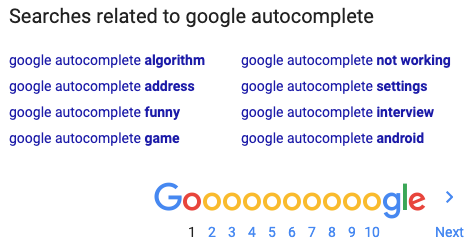
Google Related Searches also gives you insight into what users are thinking. Related searches show up at the bottom of every search engine results page (SERP) and have queries Google thinks are similar to the users.

What Content is Most Effective During the Awareness Stage of the Buyer’s Journey?

Awareness stage content marketing can come in a variety of forms. Here are some examples:

Always remember that providing engaging, useful content during the awareness stage of the buyer’s journey helps nurture prospects towards the consideration stage.

What Are Some Examples of Awareness Stage Marketing Campaigns?

Along with particular pieces that work well during the awareness stage, there are several awareness stage campaign types that can yield great results. Here are just a few:

  • Awareness campaigns are the perfect opportunity to provide prospects with valuable content that shows empathy for their situation. Demonstrate expertise and authority without being salesy, and you’ll start to gain their trust. End with a soft closing CTA and link to a piece of educational content so users can learn more if they want to.
  • Grand opening campaigns are great for prospects who haven’t heard of your business yet. If you’re opening a new location (and most of your customers are local), consider a grand opening campaign.
    Invite prospects in for a free seminar, educational course, or webinar about your company that provides helpful information without being pushy.
  • Birthday and new mover marketing campaigns are perfect for businesses who know their prospects’ birthdays or have access to data on new movers. Try targeting these people with free offers and discounts on the informational events we mentioned above. Again, don’t be pushy or try to advertise your brand too heavily in this stage.

Want help with your content marketing efforts? Our team of digital marketing specialists is here to help!

To carry on the theme of spring cleaning, I am going to talk about cleaning up your site and how to get rid of the bloat that may be costing you visits and leads. If you publish content on a regular basis, such as blog posts, podcasts, or videos, your site will inevitably grow over time. Too much content can clog up the system making it difficult for search engines to know which piece of content to deliver to the user. As your site grows, it is highly suggested that you identify the content that is not performing well or that is not helping your visitors. The main emphasis here is keeping the quality content and removing the junk.

A Real World Example

Website search results

In Tower’s case, we have covered the topic of website audits three times over the last three years. In all honesty, we don’t need three blog posts about website audits, just one will do. Therefore it was my task to find the website audit pages and compare them in terms of content value, usefulness, the amount of traffic they drive, their page authority, and links back to those pages. Once I found the page that I believed to be of the most value I had a couple of options, either:

  • no-index the pages that don’t perform as well
  • 301 redirect the lesser quality pages to the more valuable page
  • Create a new “super” page and redirect the other website audit pages to the new URL

In this case, I chose to 301 redirected the under-performing pages so that their equity would be passed onto the main website audit blog post that we wanted to promote. Let’s dig into more detail about how to do this.

Is There Such a Thing as Too Much Content?

Yes, websites can become very bloated with low-quality content that is not performing as well as other similar content pieces. When users came to the Tower website and searched for “website audit” they found at least three different results, all of which are very similar. This meant the users needed to choose which post to view, guessing at which one was most applicable to their needs. This can negatively affect the user experience. It is far better to have one result for the website audit topic. Users no longer need to make a choice, allowing them to click through more confidently

When to Delete

In some cases, when reviewing your content, it may be best to simply to delete older pages that have been added over the years. Content like old event pages, coupons that have expired, or blog posts that are outdated, incorrect or no longer apply are low-hanging fruit. Ultimately you only want pages that are applicable and offer value to the user. If a page no longer does that, you may want to consider deleting it. Note: When you delete pages, you need to 301 redirect the users to an appropriate page, otherwise it will cause your site to have broken links.

When to Consolidate

In some cases, as with the Tower Marketing example where we had three similar blog posts, it may be worthwhile creating a new page that has all the best elements of each individual page, called a “super page.” The goal here is to create a unique, high-quality piece of content that does not outdate itself and can be easily updated. Note: Doing this would require a 301 redirect to point the three older pages to the new super page.

When to Noindex

If you don’t know which pages to delete and redirect, another option would be to noindex the pages. While this does not help with duplicate content issues on your site, it can help search engine to not index a group of similar pages on the web. Tags and Categories are examples of URL extensions that we at Tower noindex because they can bloat the search results and cannibalize the rankings of pages that are more relevant. Note: Noindex still allows the bots to visit that page, they will however not be added to the SERPs.

Benefits of Cleaning Up Your Site

Cleaning up your site has several advantages, one of which is making the articles that are most important to users easy to find. Web designers and SEO’s need to work together to make sure that UX (user experience) is maintained. As mentioned earlier, having multiple search results for the same query can hinder the user journey and UX. When you clean up your site it also allows for better search results. A clean site makes it easier for search engines to index and categorize which page best represents a user’s search query. As noted above, having one super page instead of three can help rankings.

Ready to slim down your website? Contact our specialists today to start the cleanup process.

It’s not always easy brainstorming new content ideas; especially when you’ve been blogging since Day One, and you feel as though you’ve covered every topic under the sun within your industry. Trust us, we’ve been there, staring at the blank piece of paper labeled “Amazing Content Topics for XYZ Month.” So what to do when you’ve got a serious case of brainstorm block? Below we’ve outlined some creative ideas to get outside your own head when brainstorming new content ideas. Some we’ve tackled, others we can’t wait to try ourselves. Let’s dive.

The Magic of Generalized Topic Ideas

If you work with SEOs, then you know that the more niche and long-tail the focus keyword is for a content piece the better. I agree (as I AM an SEO myself). However, sometimes looking for that perfect, specific, unicorn keyword isn’t realistic. Focus, instead, on generalized topics and narrow it down from there.

For example, let’s say you work at Pets-R-Us. You feel as though you’ve beaten pet care, pet emergencies and adopting pet topics into the ground. You’ve focused on heartworm in dogs, dental care in cats, things your audience may not have known about guienea pigs, and why certain fish can’t be together in a fishbowl. You’re feeling stuck.

Instead of looking for a granular keyword, pull out your focus and pick something basic…like birds! Now, you may have written 100 blogs on birds. That’s cool; keep in mind what ones you have already written, but start narrowing down from there. Pull out as many possible bird blog ideas as humanly possible. Write a giant list of all the possible scenarios you could touch on when it comes to birds. Your list is probably getting pretty long. If you’re still feeling a bit perplexed, we tend to turn to Answer the Public. Here you can type in a keyword phrase and it provides you hundreds of questions people have asked surrounding that topic that you can answer.

Jeopardy Topic Ideas

This method has the #TeamTower stamp of approval for topic generation. If your business has multiple facets and/or product lines, pull a sample of people from each team. Come together and start writing in the form of questions about your specific department. Categorize your questions based on monetary value:

  • $100-$200 Questions: Basic, top-level questions that we receive on a pretty regular basis
  • $400-$600 Questions: Questions we receive that are a little more intensive, for the intermediate level customer
  • $800-$1,000 Questions: Questions that we ourselves ask others in the office as experts or have seen on professional forums about this product/department/skill

Set a timer for each round of questions and keep the questions for brainstorming new content pieces moving forward.

Getting Outside Your Four Walls

Oftentimes as marketers we forget that there’s a whole world of people outside our office, including a) our audience itself and b) influencers who speak the same language we do. Consider the following when brainstorming content ideas:

  • Ask current customers what they want to know more about. Send them a survey or pose the question on social media.
  • If you’re open to guest writers, pick their brains about topics they feel are your weak points on the blog and/or topics that they themselves have more experience in than you do.
  • Look at popular industry forums and see what questions other professionals are asking. Write a couple blogs that specifically answer these questions and post the link back in the forum when you’re done.
  • Reach out to businesses/consumers that might use your product/service. Ask them, if they were looking into purchasing your product/service, what questions would they want to have answered when looking at a potential site.

“Do Geckos…” and Other Recent Google Search Ideas

Screen Shot 2017-01-27 at 4.17.55 PM

It may seem too simple, but oftentimes the best ideas are. Looking for a topic? Start typing into your Google search bar and see what others have looked for recently regarding that topic. You may be surprised that many of the questions posed could all be included into one singular blog.

Imitation Is the Greatest Form of Flattery…And Then Do It Better.

Get inspired. Find other content pieces and topics that you love on Pinterest, on competitors’ sites, through popular content publications, by other influencers…and then figure out how you can either a) expand on the topic or b) make it more compelling, interesting, or entertaining.

For example, you find an amazing blog on a competitors site entitled “The First Six Months With a New Puppy.”  It explains all the vaccines you should be getting for your pup, what common health issues might pop up, training qualms to expect and growth patterns. The information is comprehensive and the writing is easily formatted enough to not be overwhelming for users. It’s a 10/10 on the content scale. So how can you do the same but better? We know humans are visual creatures. How about an infographic? How about personal anecdotes from your customers? How about a “Case by Case” scenario or a comparison chart between common breeds? In what way can you take a topic that’s already been done and make it 10X better?

Feeling like your creative well has run dry can be tough, but finding the right brainstorming technique can crack the code for the jackpot of all ideas. We wish you luck and happy writing!

How are you brainstorming content ideas? Have a topic you’d like us to write about?

In every form of internet marketing, change is inevitable. eCommerce is no different and there is a major change that will be affecting your eCommerce store. This new phenomenon is known as conversational eCommerce.

Conversational eCommerce is a method of digital marketing that encourages conversations between brands and customers who are on their purchasing journey. Actually, this is not so much a phenomenon, but rather a progressive change that was inevitable.

With more than 20 billion smartphone users worldwide, users are spending more time using their phones to search and shop. eCommerce has extended from online shopping apps to messenger apps such as WhatsApp, Facebook Messenger, WeChat, and LINE.

In this new process, the online purchase is carried out via dialog (aka conversational eCommerce). From the business side, this concept is based on chatbot software, which utilizes preset dialog patterns to analyze customer requests using text and speech recognition.

A Conversational eCommerce Success Story

Uber messenger 552x1024 1 jpg eCommerce Conversation: The "Talk" Online Businesses Need to Have

It is becoming increasingly important for brands to be able to speak with users immediately about their present needs.

Uber has done a great job of doing this.  When a client needs a ride, Uber stays in contact with them providing information about the vehicle that will pick them up, the rating of the driver, and how long they can expect to wait.

While not all businesses are as large and financially lucrative as Uber, this is a great example of how conversation leads to conversion. Uber spent a lot of money developing an app and creating software that communicates with the end-user.

For smaller businesses, you can utilize websites, forums, social media, and email to talk to your audience and engage with them.

How to Increase Conversation and Improve Engagement in eCommerce

As an eCommerce retailer, engaging with your audience is crucial to transform browsers into customers. A growing number of clients are utilizing social media, review sites, and online forums to voice their opinions.

Your potential clients want to know you’re hearing them, but how do you manage all these channels of communication? Conversation management software is how most businesses keep close tabs on what their audience requires. While this is expensive, it can invaluable in securing clients and converting them into loyal users.

However, there are other ways businesses can utilize conversation with their audience, with a much smaller investment.

Conversations and Engagement Principles

Communication needs to travel in both directions; you can’t wait for your audience to initiate conversation. Businesses need to be distributing content that invites their target audience to participate with their brand. This is the first step in reaching your audience on a personal level.

Make sure you focus your content to the needs and wants of your consumers. Show them that you are trying to understand them. We have mentioned in many previous posts that share-worthy content paves the road to success. One user sharing content from your site can have a positive ripple affects, putting your brand, products, or services in front of an audience you could have never reached otherwise.

There are three main steps to take when engaging with customers:

1. Observe

Take into account what the user has to say. This allows you to direct consumer insight. Keeping up with all your channels and notifications can be exhausting, so we suggest you use tools such as Google Alerts, Social Mention, and Talkwalker to oversee brand mentions, relevant topics, and competitors.

2. Facilitate

There is no point in having a social media presence if doesn’t help your audience communicate with you. Businesses need to be active and alert throughout all channels to best correspond with users. Tip: Include your social media links on all communication channels. This could include emails, your website, your online bio, etc

3. Join the Conversation

Always begin conversations by responding to a user’s comment to the best of your ability. Make your responses personal and avoid using industry jargon that could be confusing. From there, ask questions. This shows a user that you are really trying to understand his/her needs.

The more information you glean from the conversation, the more data you can collect and act upon. How do you capitalize on customer engagement? By using the information to personalize your customer’s experience.

Once Engagement is Underway, How Do You Make it Convert?

When you’ve learned more about your target audience, you can define your KPIs and create a user-focused strategy based on the data collected. In order for conversions to take place, you need to be observant of what words resound with customers.

What calls-to-action have been confirmed to be most successful? What are the top three questions or comments that you most frequently receive? Use this information to customize your message and attract new customers. 

How well do you know your online clientele? Are you targeting the right audience? How can you be sure? What can you do to improve the conversation between your brand and your client?

First Things First

Before we dig into how Google obtains website metrics to assess quality, it should be stated that small businesses must regularly track user engagement metrics on their websites. This should include evaluating the quality of the organic search traffic (SEO) the site is receiving. Increased website engagement will result in increased conversion rates and ROI.

User Interaction on Your Website

Assessing a user’s behavior on a website will offer strong insight as to their goals.

  1. A user lands on a site.
  2. They visit seven pages.
  3. They find a product they want.
  4. They add the product to the shopping cart.
  5. They purchase the item.

It is clear from this example that the user found what they were searching for on the website. Now, compare this with a visitor who lands on a web page and hits the browser’s “back button” in less than a few seconds. Who had the better user experience? Who engaged with the site more?

The above are examples of user engagement signals that search engines are using as data points in their algorithms to assess the quality of a site. These signals are not easily understood by the likes of Google. Search engines are private about their algorithm information because this is what separates them from the competition.

We have learned that user engagement signals are valuable in calculating search quality and may also be used as ranking signals. When a user lands on a page that does not match what they searched for, this will more than likely result in poor engagement.

If your company has a website, poor user experience is something you want to reduce and keep to an absolute minimum.

How Google Collects User Engagement Metrics

Google has a huge quantity of data sources available to them. Some of the most important ones are as follows.

SERPS (Search Engine Results Pages)

How a user interacts with the listed search results is a fundamental source of data. For example, if a user does a search in Google and decides not to click on the first or second result, but instead clicks on the third option, that can act as a signal to Google that the third result might actually be the best result for that query.

In the future, Google may adjust the ranking position of the result that was originally in third place.

Google Analytics Data

If you have Google Analytics tracking on your site, Google is able to learn how users interact with your site. This information is used by Google to learn trends and many more search abhors of users. Google Analytics can also be used to help your company improve its site so you target the right audience.

Mobile Operating Systems

With Google entering the mobile market, it’s changing how people interact with the web. Google’s Android mobile phone operating system is the most used operating system on mobile devices in the world, with more than 50% market share.

Android connects people to Google Maps, Search, and Images, impacting how a user finds and interacts with your site. Having a website that is mobile friendly and responsive is not a choice anymore.

Every business website should have these mobile features included.

Different Browsers

Browsers are influential data sources since they can monitor every action taken by a user. Microsoft’s Internet Explorer used to have the major market share back in early 2011. That all changed as Firefox and Google Chrome became more predominant.

Display Advertising

Google AdSense offers websites the ability to place ads on their sites and earn revenue when users click on them. This click data is something that helps Google understand how users interact with the site.

Toolbars

Users who install the Google Toolbar in their browsers help search engines better understand how a user navigates the web. These toolbars provide users with a lot of accessibility that can offer a better online search experience.

Goo.gl URL Shortner

There are many URL shorteners such as Bit.ly and Ow.ly. Google created a URL shortener of its own called Goo.gl. A URL shortener allows Google visibility into sharing content, even in social networks where it does not otherwise have access (for example, private Facebook pages.)

Different Forms of Online Voting

There is another set of signals that search engines measure, which we call voting mechanisms. These voting mechanisms are methods by which users directly indicate their approval or disapproval of content, services, or products. Here are some examples:

Facebook Likes

We are all familiar with Facebook’s like feature, which indicates content we like on the web. Ultimately, search engines can see what content is “liked” and gives that content more value.

Reviews

Reviews allow users to express appreciation or frustration with a product or service. Google takes these very seriously, as they are personal and inform other users.

Google is able to measure the amount of positive or negative comments to ascertain whether a website is providing quality to the user. Reviews are especially impactful when it comes to optimizing your site for local search.

Brand Name Searches

Another signal of importance is a large number of brand name searches. For example, brands like Nike and Amazon have searched hundreds of thousands of times per month.

This causes them to show up more often in results to generic search queries like athletic shoes or fiction books over lesser-known brands.

User Engagement Signals That Could Affect Rankings

Google has an in-depth collection of data sources that allow it to quantify a wide range of online user behaviors. Mentioned below are some of the major signals that Google can extract (and that you can extract, too, by looking into Google Analytics):

Bounce Rate

Bounce rate measures the percentage of users who visit only one page on a website and then leave. Bounce rate can also define the interaction of the user with the search results.

For example, if a user clicks on a search result, then returns to the SERPs and clicks on another result, that could be an indicator that the first result was not a good response for that search query.

Generating New Searches

A user may observe a set of search results, then come back to the search engine and modify his search query to better refine the results.

Click-Through Rate (CTR)

Google measures the click-through rate on links presented in the SERPs, on web pages in URL shorteners, on RSS feed readers, PDFs, and more. Many SEOs believe that CTR is actually a ranking factor when applying SEO best practices.

Time on Page

Google can measure the amount of time spent on a given page. Time on page could be considered a signal of higher quality pages(for example, the user spent time reading the whole article.)

Time on Site

Similarly, time spent on a website, as a total, is considered a positive signal. If the average user spends more time on your site than on the sites of your competitors, that might signify your site is of higher quality and relevance.

Pages per Visit

More pages viewed by a user on your site suggests greater user engagement. Viewing more pages usually signifies interest and that is something Google considers important.