
 By Alex D
 How AI is Changing PPC Strategy in 2026
- AI (AEO & GEO)
- Marketing Strategy
- PPC: Paid Advertising
Join Our Newsletter List
With endless speculation online about the relationship between AI and PPC in digital advertising, knowing where to focus your campaigns can be overwhelming.
It seems as if every week, it’s AEO, then GEO, then AI ads, then AI SEO, and so on. There’s always a new term to capture a new way of thinking when it comes to finding and promoting websites via large language models.
Today, I’m here to cut down on the noise and define exactly how AI is changing PPC strategy in 2026.
If you’re curious about how AI is affecting SEO, we go over this in great detail in Season 4, Episode 4 of our podcast Tower After Hours.
Now let’s debunk the hype.
Top Google Ads Changes From AI: Reviewing The Performance Data
So what changes are actually happening to Google because of A.I.?
Data shows that when an AI Overview appears on a query, paid ad CTR can drop significantly, and in some cases, plummet from around 19.7% down to 6.34%.
In my opinion, this is something to seriously consider about the state of Google Ads; it demonstrates that the once “gamified” way of doing things is gone and never to return.
While budget still heavily matters, the actual business processes you have set in place from offer to implementation matter more now than ever. If you don’t have the appropriate resources or infrastructure set in place to handle this traffic when received, then you may not be ready for paid advertising.
In fact, Google recently said they will start charging advertisers for some missed and follow-up calls that qualify as valid leads when using Local Service Ads on Oct. 1.
I would say this, in addition to these next statistics, is further evidence that Google is trying to only cater to those who can handle quality traffic in the first place, which honestly makes sense to me.
Between June 2024 and September 2025, paid CTR on queries featuring AI Overviews dropped by as much as 68%.
As alarming as this might be at first, I would infer that most of the query drop-off probably affected informational queries more than commercial ones.
Could this lead to a drop in conversions from keywords that may have worked for companies, such as “utility locating cost harrisburg pa” or “is iphone better than android”? Most certainly, but this would just be a signal to improve your SEO more than anything.
Speaking of SEO, did you know we can handle that for you? Reach out to partner on a pragmatic approach towards your marketing goals.
Additionally, over 80% of searches now end without a user clicking through to a website, indicating that AI answers instantly satisfy user curiosity, leaving fewer reasons to scroll down or click a traditional ad link.
On the bright side, however, in response to these documented yet critical changes to the SERP, we wrote an article directly addressing how to make long-form content more effective in an AI era here.
Don’t have the time, expertise, or hands available to craft content consistently? Or in a way that doesn’t capture your voice or speak directly to your audience?
Our Content team can capture the exact tone you’re looking for while helping you rest assured you’re represented the way you want, programmatically.
Not sure on the best way to balance tone and expertise? Visit our Content service page to begin your personalized content delivery journey today.
The Connection Between AI and PPC
Since its official launch in May 2024, AI Overviews have taken Google and other search engines by storm, becoming the main driving force behind satisfying the overwhelming majority of informational queries. So if you were ever targeting or seeing success bidding on an informational keyword such as “commercial roofing cost lancaster” or “how to find a roofing company,” you most likely aren’t seeing the same results.
The introduction of AI Overviews directly sparked “zero-click searches,” meaning that users are now finding answers to their queries without having to even click on and navigate through the SERP or the websites within the SERP.
This means that many businesses are no longer experiencing the results PPC once had, and must now start getting more creative in how they approach promoting their goods and services across the ad auction.
I even find myself not having to scroll through numerous sites or articles to find the information I am looking for in most searches. Trust me, I wish I could say I was innocent also.
PPC Advertising on Search Engines
As you may have guessed, these changes have impacted the traditional experience both users and advertisers are familiar with when using paid search. These changes mean that the Search Results page looks different and shifts how users and advertisers interact with paid search.
While PPC performance with AI may have lost visibility overall as a result of AI Overviews taking over the top spot, there are still opportunities to see success with PPC ads.
As someone who has seen this industry change so much over the past 6 years, one thing is certain: Google only wants to engage with those most likely to convert.
Ad Placements
The integration of AI Overviews into the search engine results page (SERP) has reshaped where and how ads are displayed. As advertisers, we can no longer rely on the predictable, traditional list of top-of-page text links. Instead, AI Overviews have effectively split the SERP into three dynamic paid environments:
- Above the AI Summary: For high-commercial and clearly transactional queries, Google still prioritizes immediate purchase intent. In these scenarios, standard text ads and Shopping units will often be at the very top of the page, directly above the AI Overview.
- Below the AI Summary: For mixed-intent or purely informational queries, the AI Overview almost always claims the top fold. This pushes paid results significantly further down the page. If ads appear below the AI summary, users must actively scroll past the generated answer to see them, which severely reduces their initial visibility.
- Embedded Within the AI Summary: Google is now placing Shopping ads, product listing units, & contextual sponsored links directly inside AI Overviews. Exposure here depends on your product feed quality and how Google interprets a query’s context, rather than traditional ad rank metrics.
Perhaps the biggest shift for PPC strategists is the loss of manual placement control. Google made it clear during their implementation of AI-Powered PPC Targeting that they would no longer recommend any manual ad targeting.
Currently, advertisers cannot explicitly target ad placements within AI Overviews, nor can they opt out of serving ads in them. Because AI Overviews match ads to user intent rather than exact-match keywords, achieving visibility in these new placements sometimes requires leaning into Google’s automated solutions, like Smart Bidding and Performance Max, to ensure your ad assets adapt dynamically to the AI-driven SERP.
Just remember: at the end of the day, these “ad rank” positions are no different than valuable internet real estate. To qualify for the best positions, more often than not, I believe you have to have not only the best product/service offerings, but also the highest-value and most timely bids.
If you need help choosing what placements you can and should target, which product or service offerings you should prioritize promoting with PPC campaigns, or how you can achieve the most competitive bids in the ad auction, check out our PPC Services page to learn more about what we can do for you.
AI Bidding
If there is one area of PPC where AI has won, it’s the bidding auction.
Today, AI-powered bidding (like Google’s Smart Bidding) is the core engine driving successful campaigns, fundamentally changing the strategy of managing ads.
Here is how AI bidding is changing up the rules of the auction:
- Auction-Time Optimization: Unlike manual bidding, which relies on historical averages, AI bidding evaluates millions of contextual signals (user location, past browsing behavior, specific device, operating system, & immediate intent) in a fraction of a second. It aims to help set the perfect bid at the exact moment the auction happens, a feat impossible for human account managers to replicate.
- Value-Based Bidding (VBB): The focus has shifted from simply maximizing the volume of conversions to maximizing the value of those conversions. With AI bidding strategies like Target ROAS (Return on Ad Spend), the algorithm learns to bid more aggressively for users who are statistically more likely to place a high-value order or become a lucrative long-term lead, rather than just anyone who might fill out a form. However, this requires having a strong grasp of your average CPA, pipeline, and follow-up sequences.
- The “Garbage In, Garbage Out” Reality: Because the AI algorithm controls the actual bids, a marketer’s success now completely depends on the data they feed the machine. AI bidding is only as smart as its inputs. If you are feeding the system poor conversion tracking or failing to upload offline CRM data, the AI will confidently optimize in the wrong direction.
Just to be clear, AI bidding doesn’t eliminate the need for PPC strategists; it shifts our role.
Instead of “pulling levers,” I find myself now “feeding data” in my campaigns. Success now relies on setting the right strategic targets, integrating high-quality first-party data when possible (like CRM offline conversions and profit margins), and giving the algorithm the creative assets and callouts it needs to test and win.
AI in PPC Campaign Optimization
Google also introduced AI-powered PPC campaign recommendations to make it easier and more direct for users to have real-time feedback based on the ad’s results and to audit the ad’s completion statuses against best practices.
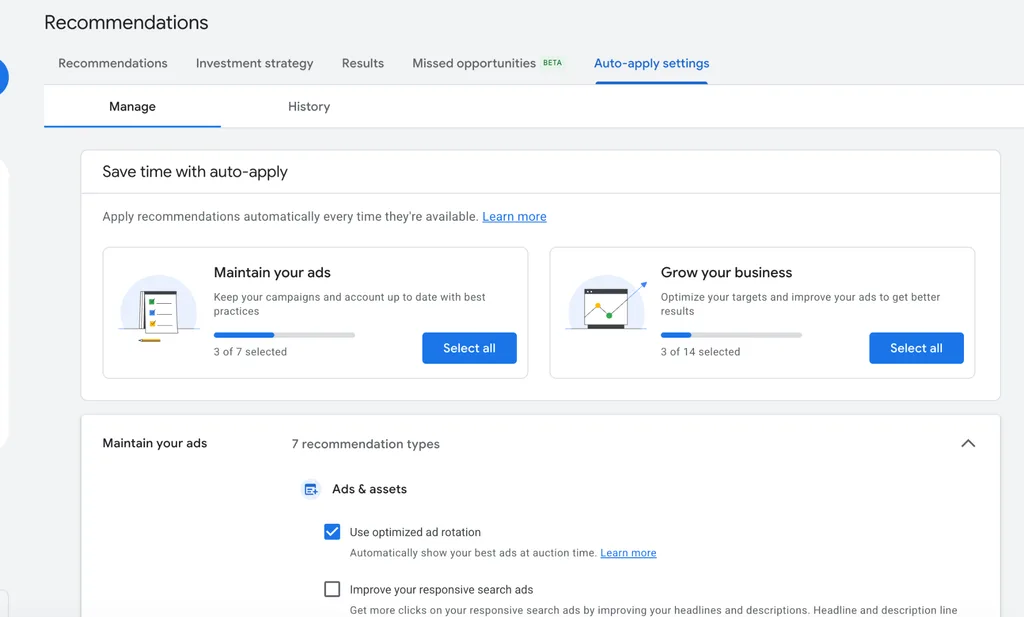
These recommendations are categorized into two groups: Maintain Your Ads (asset improvement advice) and Grow Your Business (bidding improvement advice). They are presented to you within the “Recommendations” tab, and checking them off improves your “recommendation score” based on what Google’s algorithm deems beneficial.
You can even set up PPC automation using AI by triggering “Auto-Apply.” This setting monitors your ads based on your selected parameters and automatically implements changes to your PPC campaigns aligned with your budget and optimization goals.

Too many ad platforms and features to think about and manage? Let our team manage your ads across search and social media.
PPC Advertising on Large Language Models (LLMs)
As users increasingly turn to chatbots for complex, multi-turn questions, the advertising model is moving away from traditional, isolated keyword triggers.
In an LLM environment, ad relevance is determined by evaluating the broader context and intent of an ongoing conversation.
Rather than bidding on a single search term, large language models are programmed to analyze their landing pages, copy, and advertiser-provided context hints to naturally match their brand to the user’s dialogue.
Ad Placements in LLMs
Unlike a traditional SERP with rigid top-of-page and sidebar slots, ad placements in LLMs are integrated directly into the chat interface. For example, when OpenAI introduced ads for its free-tier ChatGPT users in early 2026, they opted for a visually separated approach.
In these interfaces, sponsored product cards and text ads appear beneath the AI’s generated response.
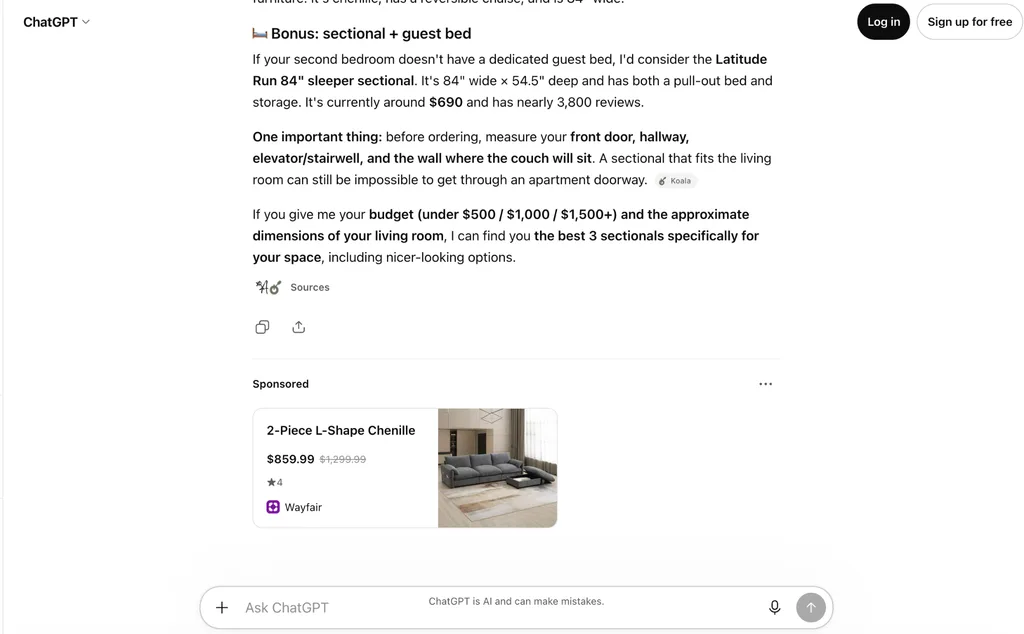
Depending on the relevance and length of the chat, the interface might display one or multiple ad units from different advertisers directly in the flow of the conversation.
The Challenge of Bias and Trust
The introduction of ads into LLMs brings ethical and performance considerations that PPC managers haven’t had to worry about on traditional search engines. While platforms outwardly state that ads run on separate systems and do not influence the AI’s core answers, independent testing suggests a more complex reality.
An August 2026 study analyzing conflicts of interest in AI chatbots found that some LLMs occasionally prioritize company revenue incentives by recommending more expensive sponsored products or surfacing sponsored options that disrupt the natural purchasing process.
I would say a big takeaway from this is ensuring your sponsored placements add value rather than feeling overly aggressive or irrelevant to the conversation.
If users begin to feel manipulated by the chatbot’s recommendations, it could ultimately damage trust in the brands being advertised.
Learn more in our blog covering how AI is changing the consumer buying journey. With the introduction of AI, Commerce has become less commercial and more conversational.
Now let’s recap some of the most important tips to include in your strategies when advertising with AI, and on AI platforms such as ChatGPT.
I’ll start with Search Engines:
PPC Optimization Checklist for AI on Search Engines
- Adopt Value-Based Smart Bidding When Applicable: Shift away from manual bid management and rely on machine learning algorithms like Target ROAS or Target CPA to make auction-time decisions when the time is right. Otherwise, continue to rely on Maximize Clicks and Maximize Conversions.
- Feed the Machine with First-Party Data: Ensure reliable lead tracking by utilizing CRM integrations, offline conversion imports, and revenue signals to provide the algorithm with meaningful optimization data.
- Shift Focus to Search Intent Over Volume: Prioritize keywords with strong commercial intent rather than chasing sheer volume, as AI Overviews often absorb upper-funnel informational queries.
- Maximize Performance Max When Necessary: For ecommerce, maintain a healthy Merchant Center feed filled with strong product data, clear product margins, and high-quality visuals.
- Upgrade Landing Page Quality: AI automation requires better post-click experiences; ensure your pages have clear CTAs, trust signals, fast mobile loading, and industry-specific messaging.
Moving on to platforms like ChatGPT, here is a quick ppc advertising in AI checklist I recommend:
PPC Advertising on Large Language Models Checklist
- Optimize for Conversational Intent: Move beyond isolated keyword bidding and structure campaigns to align with natural language, multi-step user journeys, and follow-up questions.
- Create In-Depth, Explanatory Content: Build comprehensive content that clearly explains your value proposition, giving AI systems the necessary context to surface your brand as a relevant recommendation.
- Blend Paid and Organic Strategies: Adopt strong organic SEO best practices alongside your PPC setup to deliver genuine value to both human users and AI crawlers.
- Anticipate Comparison Queries: Prepare for users asking AI assistants to compare service providers, pricing structures, or specific solutions, ensuring your brand stands out in competitive contexts.
- Focus on Contextual Relevance: Remember that LLMs analyze the overall flow of the conversation; ensure your messaging naturally integrates into conversational recommendations rather than feeling like an interruptive banner ad.
Final Takeaway: Is It Really Worth Using AI In Your PPC Advertising?
It depends. As with most digital marketing advice, whether or not I recommend it depends on whether the benefits outweigh the drawbacks, which is completely dependent on your goals.
If you mostly want to automate certain updates to your ads, such as headline testing, asset experimentation, or AI bidding strategies for ppc that utilize AI for ad tracking and scheduling to help meet strict CPC or CPA targets, then using AI could very well be worth your while on a platform like Google Ads or Bing Ads.
However, if you prefer more manual control over your campaigns, AI PPC management may not be a fit.
If you want to run ads on an AI-powered platform like ChatGPT or Copilot, I recommend making sure you understand exactly how these language models show ads within conversations and how they weigh bids in their auction systems.
This will help you set appropriate goals for targeting users within these language models, providing you with data to decide how much you are willing to spend based on potential visibility and ad placement.
Partnering with a proactive marketing agency like Tower can help you decide what’s best for your business.
Together, we can make a deeply personal, highly specialized plan to bridge the gap between your future aspirations and present reality.
Whether you do or don’t know what you need, we’re here to help you get more out of your digital marketing. We’ll design a creative and results-oriented approach to help you rise above the rest.
 Grace H
 AI Overviews, SEO, & Your Content: What’s Happening With Organic Search Right Now?
- AI (AEO & GEO)
- Content Marketing
- SEO
 Tim
Tim