0

In 2014, online and eCommerce sales accounted for $101.9 billion of the total holiday retail sales. An increase of 6.8% from the previous year. It’s no surprise that online shopping is growing into a major contributor of holiday sales. So much so that it’s spawned several of it’s own holiday shopping milestones, including Cyber Monday and Free Shipping Day.

So whether you run an online store only or your eCommerce platform supports a physical retail store, it’s important to understand the psychology of online shopping, what motivates buyers and why online consumers make the choices they do. As you put together your seasonal promotions plan, consider these strategies, inspired by how shoppers think, to motivate online purchases on your site.

Make Sure Shoppers Are in the Mindset for Shopping

An important first step is to understand when people are shopping. This way you can “speak” to them when they are in the mindset to make purchases. Shopify has shown that people begin searching Google for Christmas ideas as early as August!

Of course, all retailers prepare for the official kick-off to the holiday shopping season, both in-store and online, Black Friday and Cyber Monday. Additional dates that have become top performers in the lead-up to the holidays are:

  • Green Monday – The second Monday in December is named Green Monday for the influx in cash it brings to retailers. This is the date when people start to feel the crunch and stop procrastinating.
  • Free Shipping Day – In 2015, Free Shipping Day is being celebrated on December 18. Promoted by countless online retailers, they will provide free shipping on standard deliveries, and can still offer delivery by Christmas Eve.
  • Super Saturday – This is the last Saturday before Christmas and a big day for those who typically save their shopping for the last minute.

Keep these dates in mind when you are planning out your sales and promotions throughout November and December.

top holiday spending days

Create A Sense of Online Urgency

psychology of online shopping - limited inventory

This is a classic example of FOMO! That’s Fear of Missing Out and the struggle is real. No one wants to miss out on the perfect gift or the biggest savings. Take a page from the grandaddy of online retailers, Amazon, and call out items with a dwindling inventory.

Amazon uses “20 left in stock” as their trigger to promote purchase urgency. If you have an item that does sell quickly and goes out of stock, allow online shoppers to sign up for an email alert when inventory is replenished. The follow-up email can also spark a fire for shoppers to get their purchase completed.

psychology of online shopping - countdown

Additionally, you can use a countdown feature to show shoppers exactly how many days, hours, or minutes they have to take advantage of a site-wide sale or special promotion. As the days tick by, add a “Need it By Christmas?” callout to each product page. Tell shoppers how many days are remaining to place their order so that it arrives by Christmas Eve.

Keep Online Shoppers Happy

Did you know that coupons bring happiness? A study from Coupons.com and Claremont Graduate University proved that coupon recipients experience signs of happiness, lowered stress, and relaxation. And while coupons and discount codes are a staple of online promotions, the psychology of online shopping shows that they still bring joy.

So what’s the winning discount strategy? A percentage off? A set dollar amount savings? A BOGO offer? There may not be a concrete answer, as every shopper may be enticed by a different promotion. We recommend implementing A/B testing into your email marketing strategy to see which offer resounds best with your customers. With all else created equal, same subject; same graphics; same delivery date; same products, test two different offer types (20% off or $25 off) to see which results in more purchases.

Also, consider an element of exclusivity in your discount offers. Create a flash sale, a sneak peek event, a bump in savings, or added 2-day shipping for select customers. Segment individuals who have signed on for loyalty programs, repeat customers, or first-time visitors. Making someone feel special is never a bad thing.

Get Online Shoppers Over the Final Hump

psychology of online shopping - shipping dates

One reason that some shoppers choose to shop in retail stores is that they can avoid the added shipping costs associated with ordering online. Shipping charges are often cited as the main reason that an online shopper will abandon their shopping cart. Whether you offer periods of site-wide free shipping or an everyday free shipping thresholds, shipping promotions can break down that mental block that shoppers have about buying online. Be sure that you’re clearly communicating your shipping policies and, more importantly, cut-off dates for packages to arrive in time for the holidays.

Also, consider offering free returns. Many times shoppers are reluctant to purchase products online because if things don’t work, they have to pay to return their items. Zappos was one of the first online retailers to offer Free Shipping & Free Returns and has built a loyal fan base because of this generous customer service strategy.

Need help understanding the psychology of online shopping and what goes on inside the brains of online shoppers? Contact our team for our marketing advice.

The stats on including visuals in your content are staggering. 90% of information transmitted to the brain is visual. 40% of people will respond better to visual information than plain text. Posts generate 94% percent more views if you add compelling visual elements. In addition, all the major social media platforms are giving more prominence and exposure to posts that include a visual element.

If you’re design challenged (raising my hand!) and don’t have a design team at your disposal, I suggest these three tools for visual content marketing that will have you creating Twitter covers, blog headers, infographics, and incorporating top-notch photography like the true artist your 5-year-old self always thought you could be!

canva- tools for visual content marketing

Canva

The beauty of Canva is that they offer templates for any kind of visual content you need to create. Whether it’s a Facebook or Twitter cover photo, Pinterest graphic, blog image or title header, or social ads, they offer numerous templates in a variety of styles. The pre-designed templates, allow you to simply tweak the copy to suit your needs or delete components down to a simple background image and then begin building a unique design.

As a tool for visual content marketing, I tend to use Canva not for template designs, but for smaller graphic pieces. Canva offers, what seems like, an unending supply of modern and quirky little icons, word bubbles, illustrations, photography, and holiday and seasonal images that make Clipart look ridiculously outdated. (Which it is. So please stop. Stop using it.)

There are so many free elements on Canva, but if you fall in love with a background or icon that does cost you something, you’ll find you won’t pay more than $1.
piktochart- tools for visual content marketing

Piktochart

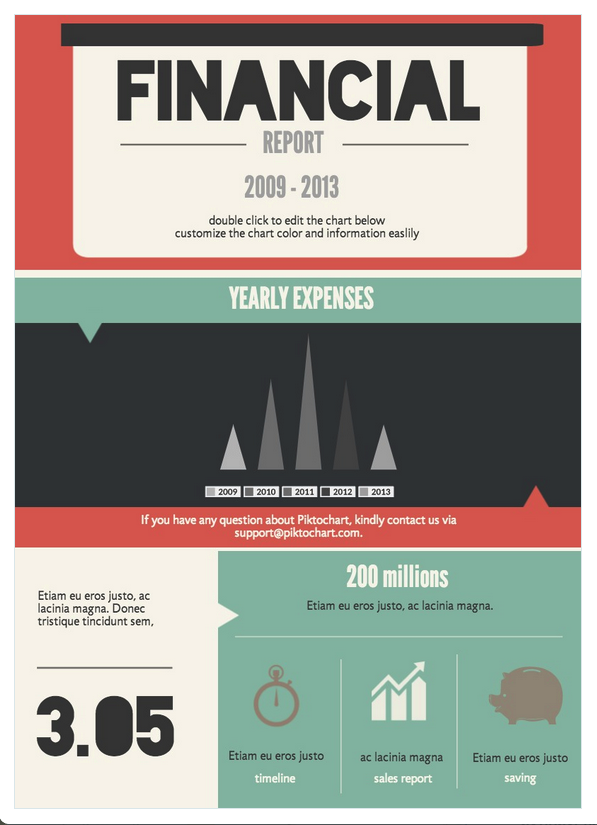
Piktochart is a lot like Canva, but instead of social media or blog images, they offer templates for infographics. They offer over 400 ready-to-use designs, although most of them fall under the Go Pro package ($29 per month/$290 annually). However, there are free themes available and I’ve always found something free that suits my needs. They are eye-catching and modern, and categorized for easy browsing. There is also a gallery of recently created Piktocharts to use as inspiration.

Although you’re starting with a pre-designed template, you can edit just about every element of the design. Change titles and body copy, colors, or images using editing tools that are easy and intuitive. You can even add or remove blocks of content to make your infographic longer or shorter as necessary. Start with a template comparing the benefits of tea and coffee and end up with a infographic comparing different student loan options.

What I like about Piktochart is that for a design illiterate like myself, I don’t have to worry about choosing colors and fonts that work well together. That’s all taken care of for me.

DeathtoStock_SlowDown2

Death to the Stock Photo

I saw this slideshare shared on Google + not that long ago and I loved the ideas they shared on how to turn cold, generic, Stepford stock photos into something a little more edgy and interesting. In addition, I also stumbled across Death to the Stock Photo.

The site was started by two photographers who wanted to make their work available for friends who were writers, artists, freelancers, etc. Once you sign up on the site, a pack of stock photos is emailed to you at the start of each month. You don’t even have to think about it, it just shows up! You download the pack and the images are yours to use. Each month comes with a new theme – Wired, Slow Down, and Creative Space, are a few examples. Some months the images aren’t exactly a good fit for the clients I work with, while other months it’s a total jackpot!

They also have a Premium service, where in addition to the monthly pack, you also have access their library of over 400 images for $20 per month.

Share your go-to tools for visual content marketing! Or if you want to add visual content to your marketing strategy, contact our team!