It’s not always easy brainstorming new content ideas; especially when you’ve been blogging since Day One, and you feel as though you’ve covered every topic under the sun within your industry. Trust us, we’ve been there, staring at the blank piece of paper labeled “Amazing Content Topics for XYZ Month.” So what to do when you’ve got a serious case of brainstorm block? Below we’ve outlined some creative ideas to get outside your own head when brainstorming new content ideas. Some we’ve tackled, others we can’t wait to try ourselves. Let’s dive.
The Magic of Generalized Topic Ideas
If you work with SEOs, then you know that the more niche and long-tail the focus keyword is for a content piece the better. I agree (as I AM an SEO myself). However, sometimes looking for that perfect, specific, unicorn keyword isn’t realistic. Focus, instead, on generalized topics and narrow it down from there.
For example, let’s say you work at Pets-R-Us. You feel as though you’ve beaten pet care, pet emergencies and adopting pet topics into the ground. You’ve focused on heartworm in dogs, dental care in cats, things your audience may not have known about guienea pigs, and why certain fish can’t be together in a fishbowl. You’re feeling stuck.
Instead of looking for a granular keyword, pull out your focus and pick something basic…like birds! Now, you may have written 100 blogs on birds. That’s cool; keep in mind what ones you have already written, but start narrowing down from there. Pull out as many possible bird blog ideas as humanly possible. Write a giant list of all the possible scenarios you could touch on when it comes to birds. Your list is probably getting pretty long. If you’re still feeling a bit perplexed, we tend to turn to Answer the Public. Here you can type in a keyword phrase and it provides you hundreds of questions people have asked surrounding that topic that you can answer.
Jeopardy Topic Ideas
This method has the #TeamTower stamp of approval for topic generation. If your business has multiple facets and/or product lines, pull a sample of people from each team. Come together and start writing in the form of questions about your specific department. Categorize your questions based on monetary value:
$100-$200 Questions: Basic, top-level questions that we receive on a pretty regular basis
$400-$600 Questions: Questions we receive that are a little more intensive, for the intermediate level customer
$800-$1,000 Questions: Questions that we ourselves ask others in the office as experts or have seen on professional forums about this product/department/skill
Set a timer for each round of questions and keep the questions for brainstorming new content pieces moving forward.
Getting Outside Your Four Walls
Oftentimes as marketers we forget that there’s a whole world of people outside our office, including a) our audience itself and b) influencers who speak the same language we do. Consider the following when brainstorming content ideas:
Ask current customers what they want to know more about. Send them a survey or pose the question on social media.
If you’re open to guest writers, pick their brains about topics they feel are your weak points on the blog and/or topics that they themselves have more experience in than you do.
Look at popular industry forums and see what questions other professionals are asking. Write a couple blogs that specifically answer these questions and post the link back in the forum when you’re done.
Reach out to businesses/consumers that might use your product/service. Ask them, if they were looking into purchasing your product/service, what questions would they want to have answered when looking at a potential site.
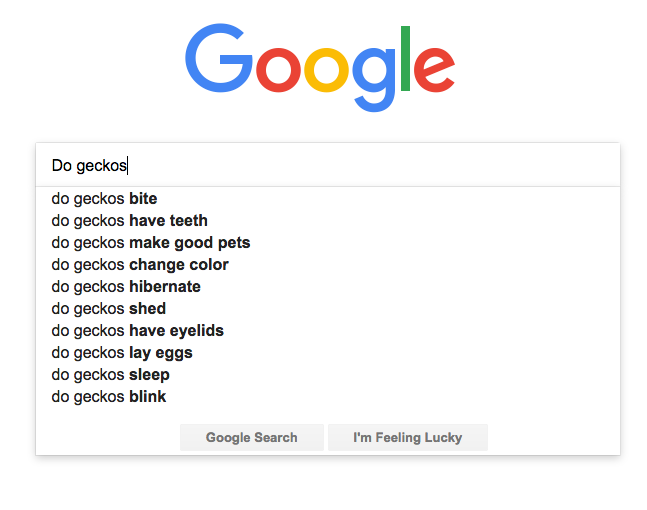
“Do Geckos…” and Other Recent Google Search Ideas
It may seem too simple, but oftentimes the best ideas are. Looking for a topic? Start typing into your Google search bar and see what others have looked for recently regarding that topic. You may be surprised that many of the questions posed could all be included into one singular blog.
Imitation Is the Greatest Form of Flattery…And Then Do It Better.
Get inspired. Find other content pieces and topics that you love on Pinterest, on competitors’ sites, through popular content publications, by other influencers…and then figure out how you can either a) expand on the topic or b) make it more compelling, interesting, or entertaining.
For example, you find an amazing blog on a competitors site entitled “The First Six Months With a New Puppy.” It explains all the vaccines you should be getting for your pup, what common health issues might pop up, training qualms to expect and growth patterns. The information is comprehensive and the writing is easily formatted enough to not be overwhelming for users. It’s a 10/10 on the content scale. So how can you do the same but better? We know humans are visual creatures. How about an infographic? How about personal anecdotes from your customers? How about a “Case by Case” scenario or a comparison chart between common breeds? In what way can you take a topic that’s already been done and make it 10X better?
Feeling like your creative well has run dry can be tough, but finding the right brainstorming technique can crack the code for the jackpot of all ideas. We wish you luck and happy writing!
How are you brainstorming content ideas? Have a topic you’d like us to write about?
Before we dig into how Google obtains website metrics to assess quality, it should be stated that small businesses must regularly track user engagement metrics on their websites. This should include evaluating the quality of the organic search traffic (SEO) the site is receiving. Increased website engagement will result in increased conversion rates and ROI.
User Interaction on Your Website
Assessing a user’s behavior on a website will offer strong insight as to their goals.
A user lands on a site.
They visit seven pages.
They find a product they want.
They add the product to the shopping cart.
They purchase the item.
It is clear from this example that the user found what they were searching for on the website. Now, compare this with a visitor who lands on a web page and hits the browser’s “back button” in less than a few seconds. Who had the better user experience? Who engaged with the site more?
The above are examples of user engagement signals that search engines are using as data points in their algorithms to assess the quality of a site. These signals are not easily understood by the likes of Google. Search engines are private about their algorithm information because this is what separates them from the competition.
We have learned that user engagement signals are valuable in calculating search quality and may also be used as ranking signals. When a user lands on a page that does not match what they searched for, this will more than likely result in poor engagement.
If your company has a website, poor user experience is something you want to reduce and keep to an absolute minimum.
How Google Collects User Engagement Metrics
Google has a huge quantity of data sources available to them. Some of the most important ones are as follows.
SERPS (Search Engine Results Pages)
How a user interacts with the listed search results is a fundamental source of data. For example, if a user does a search in Google and decides not to click on the first or second result, but instead clicks on the third option, that can act as a signal to Google that the third result might actually be the best result for that query.
In the future, Google may adjust the ranking position of the result that was originally in third place.
Google Analytics Data
If you have Google Analytics tracking on your site, Google is able to learn how users interact with your site. This information is used by Google to learn trends and many more search abhors of users. Google Analytics can also be used to help your company improve its site so you target the right audience.
Mobile Operating Systems
With Google entering the mobile market, it’s changing how people interact with the web. Google’s Android mobile phone operating system is the most used operating system on mobile devices in the world, with more than 50% market share.
Android connects people to Google Maps, Search, and Images, impacting how a user finds and interacts with your site. Having a website that is mobile friendly and responsive is not a choice anymore.
Every business website should have these mobile features included.
Different Browsers
Browsers are influential data sources since they can monitor every action taken by a user. Microsoft’s Internet Explorer used to have the major market share back in early 2011. That all changed as Firefox and Google Chrome became more predominant.
Display Advertising
Google AdSense offers websites the ability to place ads on their sites and earn revenue when users click on them. This click data is something that helps Google understand how users interact with the site.
Toolbars
Users who install the Google Toolbar in their browsers help search engines better understand how a user navigates the web. These toolbars provide users with a lot of accessibility that can offer a better online search experience.
Goo.gl URL Shortner
There are many URL shorteners such as Bit.ly and Ow.ly. Google created a URL shortener of its own called Goo.gl. A URL shortener allows Google visibility into sharing content, even in social networks where it does not otherwise have access (for example, private Facebook pages.)
Different Forms of Online Voting
There is another set of signals that search engines measure, which we call voting mechanisms. These voting mechanisms are methods by which users directly indicate their approval or disapproval of content, services, or products. Here are some examples:
Facebook Likes
We are all familiar with Facebook’s like feature, which indicates content we like on the web. Ultimately, search engines can see what content is “liked” and gives that content more value.
Reviews
Reviews allow users to express appreciation or frustration with a product or service. Google takes these very seriously, as they are personal and inform other users.
Google is able to measure the amount of positive or negative comments to ascertain whether a website is providing quality to the user. Reviews are especially impactful when it comes to optimizing your site for local search.
Brand Name Searches
Another signal of importance is a large number of brand name searches. For example, brands like Nike and Amazon have searched hundreds of thousands of times per month.
This causes them to show up more often in results to generic search queries like athletic shoes or fiction books over lesser-known brands.
User Engagement Signals That Could Affect Rankings
Google has an in-depth collection of data sources that allow it to quantify a wide range of online user behaviors. Mentioned below are some of the major signals that Google can extract (and that you can extract, too, by looking into Google Analytics):
Bounce Rate
Bounce rate measures the percentage of users who visit only one page on a website and then leave. Bounce rate can also define the interaction of the user with the search results.
For example, if a user clicks on a search result, then returns to the SERPs and clicks on another result, that could be an indicator that the first result was not a good response for that search query.
Generating New Searches
A user may observe a set of search results, then come back to the search engine and modify his search query to better refine the results.
Click-Through Rate (CTR)
Google measures the click-through rate on links presented in the SERPs, on web pages in URL shorteners, on RSS feed readers, PDFs, and more. Many SEOs believe that CTR is actually a ranking factor when applying SEO best practices.
Time on Page
Google can measure the amount of time spent on a given page. Time on page could be considered a signal of higher quality pages(for example, the user spent time reading the whole article.)
Time on Site
Similarly, time spent on a website, as a total, is considered a positive signal. If the average user spends more time on your site than on the sites of your competitors, that might signify your site is of higher quality and relevance.
Pages per Visit
More pages viewed by a user on your site suggests greater user engagement. Viewing more pages usually signifies interest and that is something Google considers important.
Taking the above metrics and values into account, how can you improve your website’s value to users so they have a better search experience and keep revisiting your site?
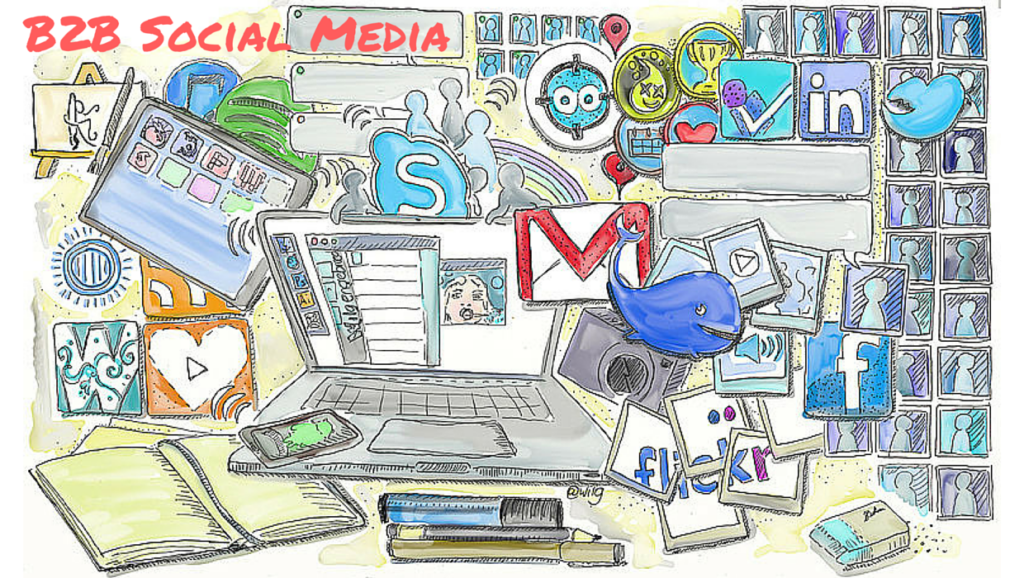
Welcome to one of the most difficult marketing strategies to date: B2B social media.
If you’re a B2B company, you’re probably familiar with the challenge of wrangling your audience through social media. You may have thought to yourself, “Is social media even worth it for us? How can we possibly reach big-ticket clients through social media?”
We’re here to tell you with a resounding, “YES!” that social media means business for B2B.
But maybe not in the more obvious ways social media works for a B2C.
You’re probably thinking about your B2B social media strategy the wrong way. Several companies look at B2C and B2B social media similarly, but there are some differences:
B2C Social Media
B2C social media serves several different purposes:
Engaging with potential audiences in creative and compelling ways
Promotion and advertisements
Sharing relevant content to users appear as a thought leader
Grow a following and, ultimately, brand awareness
Massage users through the top of the sales funnel
B2B Social Media
B2B social media shares some of the same purposes (like sharing relevant content and growing brand awareness), but two big differences are:
Building relationships with industry leaders
Becoming the authority (keyword: THE)
B2B social media is about building relationships and setting yourself up as an authority figure in your industry. By using the right social media outlets, you’re able to foster conversations, teach others in your field, and establish yourself as THE influencer potential clients look to for information and advice.
In more ways than one, B2B social media is much more granular, targeted, and personalized. Instead of trying to reach and engage with 1,000+ users, you may only be targeting 20 people who fit the decision-maker persona for your product or service.
If you’re ready to dive into B2B social media for your company, we have outlined three important things you need to know before moving forward.
Number One: What Platforms Should I Use?
Good question. We’ve asked ourselves this many times for our clients. Go to the drawing board and answer the following questions.
Who is Our Typical User Persona?
What social media platforms are your decision-makers conversing on? Or, what social media sites do they turn to for advice? If they’re sitting sipping coffee in the morning, what sites are they scrolling through on their phones?
Where is Our Competition Hanging Out?
Where do you have the potential to overtake your competition? Where is your competition beating you now?
What DOESN’T Make Sense?
Not all social media outlets make sense for B2B companies. Sometimes a little reverse psychology works wonders. By determining what social outlets make NO sense (like Snapchat for customer service companies) it helps you narrow down which outlets DO make sense.
Where Do We Turn to for Industry Advice?
Look at your own company habits when looking for advice or new services. Do you flock to Facebook for critical updates and news? Do your colleagues constantly forward LinkedIn articles from their favorite services? Sometimes examining our own patterns help us determine natural courses of action for our clients.
What Would this Platform Look Like in 5 Years?
It’s easy to say you want X amount of followers or X amount of shares when you’re a B2C company. The more the merrier! But B2B social media is more strategic. What kind of relationships do you want to see in 5 years? How do you want to position yourself as a leader on social media and what platform will help you position yourself as such the most?
If you’re really stuck, generally speaking, LinkedIn and Facebook are leaders in B2B marketing. However, Twitter is the second highest leader for conversions (we were surprised, too!). Mix the right social media cocktail for your B2B efforts; never rely on just one platform to produce the best results.
Number Two: Foster Conversation & Answer Questions
Much of B2B social media is about building relationships. It’s not enough to just gain awareness; you have to get into the trenches and start the conversations.Here is how you can utilize the most popular social media platforms for B2B companies to do just that.
LinkedIn
First and foremost, if you’re not on LinkedIn, you should be. Secondly, look for groups to join on LinkedIn where potential leads could be congregating and asking questions. This is a perfect opportunity for you to shine as an industry expert and answer questions, spread your knowledge base, or to simply be present and gain awareness as a group member.
We all know Content is King. Don’t skimp on offering real, quality content on your B2B Facebook page; companies are made of professionals all looking for resources. However, consider the type of content these professionals are looking for and when they’re looking for content.
If the majority of your Facebook audience is active after hours, consider longer pieces of content (like a Whitepaper). They’ll be able to dig into after hours and share at the office in the morning.
Is lunch time your Facebook’s prime time? Shorter articles or text visuals might be a better bet. Consider even tacking on the reading time so your users know exactly what to expect when they click on your content.
And remember, it’s not all about you. Overly promotional B2B companies don’t get anywhere. You want to warm your Facebook users up with softer content. Allow followers to familiarize themselves with your brand first. Especially for larger companies whose sale cycle is normally much longer than B2C companies, soft content pushes are better than constant promotions. You’re playing the long game.
Bulk up on your portfolio page. Have all the information your potential leads need to find out more about you; and always lead back to your site or a specified landing page
Follow those leaders and engage, engage, engage (and then engage some more). You could do something big like a virtual event or something as small as a “Thank You” when somebody retweets.
Don’t ignore following companies that are potential clients. Observe what types of content they share and find useful for their own clientele. You can use this to your advantage when creating your content. If you engage with these companies over social, chances are their decision maker is following THEM and will take note.
“The second, and most important thing you’ll want to do is set up a remarketing tag on your website…The whole process takes about five minutes for someone who knows the basics of navigating a website’s backend…you’ll begin capturing your website visitors so that you’re able to remarket to them at your leisure.”
So what about newer markets and more off-the-cuff B2B platforms like Tumblr, Snapchat, Instagram, or YouTube?
To each his own. While Snapchat, Instagram, and YouTube haven’t been big players in the B2B social media game, it doesn’t mean these social media platforms won’t mean big things for companies in the future.
Most social media platforms start out as entertainment, but as they become more popular (and by more popular I mean, millions of users), B2B companies can’t ignore the potential. As mentioned previously, businesses are made up of thought leaders in every industry. These thought leaders can be found on every social media platform, including the more niche and risky.
If you have the time and talent to create compelling and diverse content for these platforms, and you feel enough of your potential client bases’ employees congregate here, we say take the plunge! It never hurts to be in on the ground levelof a newer social media platform, as long as the platform has some proven success. #RIPPeach
As Gary Vaynerchuk, CEO of VaynerMedia, says, “There will be some plumber in America who becomes famous by doing two minute videos broken up in 20 sections on how to fix things yourself.”
Number Three: Maintenance & Growth
Crafting and strategizing B2B social media is one thing; maintaining and growing that network is something else. We’ve already talked about engagement, but what other ways can you maintain and grow social media for your B2B company?
A Killer Landing Page
While the sales cycle for a B2B company may be longer, the funnel is almost exactly the same. Make it crystal clear to users how to find more information. Always lead your followers back to either your home page or a specified landing page (or several, if you’re Salesforce.)
It’s especially important for B2B companies to track and analyze what happens to their followers once they click off their social page onto their own site. Are the right people clicking? What information are they going to? Are they hopping from page to page? Is the landing page too stringent? Not stringent enough?
Explore landing page options and A/B testing like your company’s life depends on it; because it just might.
Social Media Advertisements
Facebook can be described as a “pay to play” platform. If you want to grow your follower base and reach a larger number of professionals, you gotta have some skin the in the game. Facebook, Twitter and Instagram advertising are a relatively low cost / high reward tactic.
Social advertising has increased phenomenally over the past five years and shows no signs of slowing down. With social advertising you are able to target audiences on a much more granular level while also reaching the ever-growing surge of mobile users.
Understand Your Growing Follower Base’s Needs & Wants
It’s easy to find high profile thought leaders; they’re right out in the open! As your user base continues to grow, however, you may be missing some influential people in your follower list that could reap major benefits for your company with some interaction. Dig into your follower list to understand a) Who’s following you and b) What they’re talking about.
Tools that Work Best?
Followerwonk – Analyze your Twitter analytics and discover what segments you can pull apart in your audience and how to best optimize for reach.
BuzzSumo- Find out what topics are being shared in relation to your industry; this helps you be more timely and relevant
Social media changes at the drop of a hat. What might have worked yesterday doesn’t work today (especially with mobile apps taking a larger piece of the pie in dominance).
But your audience should come first and foremost. If more and more B2B companies are transitioning to GIF’s and short snippets of information, but your audience is still watching your five minute How-To videos and engaging, why change?
Keep a pulse on your audience. Trends are often tied to certain industries. What might be working for energy companies may not be what works for publishing houses.Always go back and reevaluate your audiences. Ask the sales team if they’re seeing different questions coming through. Is customer service hearing the same suggestions over and over? Ask leadership if your followers are really reticent of your company clientele.
Redraft if need be and stand away from the crowd when it calls for it.
If you’re looking for awesome B2B social media mavens, check out what these three companies are doing:
B2B social media doesn’t have to be scary. Find the right platforms, engage with the right people and follow (or don’t follow) the right trends. B2B over and out.
Struggling to find B2B tactics that work well for your company? Partner with our team of experts to develop a marketing strategy right for you.
As a business, you have your own tasks and duties to focus on. That’s why you hired an agency to do your marketing in the first place, right? Not quite. You want to see results from the agency you hire, but there is a big difference between good results and great results – YOU. All too often, clients hire an agency to do their digital marketing and then don’t partake in the process. I’m not blaming clients for this; rather, I want to stress that businesses that hire marketing agencies should be involved from A-Z . That is when they will see the best results.
Why Do Clients Need to Collaborate with the Marketing Agency?
There needs to be agency and client collaboration for any and all digital marketing services to achieve the best results. Good marketing is relational by nature. Nurturing and understanding from both the client and agency contributes to online success. Find out why your business should be involved with your marketing agency’s plans and projects:
Clear Communication and Understanding Goals from the Get-Go
This might seem obvious, but it is often overlooked. There should be an initial discovery discussion where the agency can ask questions to better understand your business, culture, target audience, needs, and business approach. The marketing agency needs to learn about the current state of your business so it can prepare to move ahead with a solid plan. You, as their client, are who will shed that much-needed light.
Being Involved Means Understanding the Process
A large reason why I encourage clients to be involved with the marketing execution is so they understand the process.
Clients will have a better understanding of timelines for creating a website, creating an SEO campaign, or developing creative content.
Clients will be able to offer insight as the agency makes progress.
Clients will have a better sense of what to communicate to higher management
Trust and Transparency
When a client is involved, sharing ideas and being a team member, this allows for transparency. When there is nothing to hide, there will be no nasty surprises for either party to be caught unaware and have to fix. Developing a working relationship on a regular basis with an agency prevents miscommunication, helps to move the process along, and encourages an environment of trust. Where there is trust and transparency between client and agency, there are productive marketing results.
A Stronger Force
The marketing agency does not know your business as well as you do. That is why it is imperative for your business to be involved in all areas of marketing efforts being carried out by the agency. The client should be the face(s) of the company, not the agency. People trust you more than your agency. The agency is more of a supportive device rather than the front-facing part of your company. As a result, when an agency supports the client, the client will be more willing to support the marketing efforts of the agency. This collaboration will produce a stronger force that can achieve more.
The Client Becomes Better at Marketing
Through collaboration with the agency, the client will become a well-oiled marketing machine. By building relationships and working in a transparent environment, the client will naturally become better educated in internet marketing.
Better Results
Clients hire a marketing agency to get results. A marketing agency that has the collaborative efforts of their clients will be able to do more in less time and with a better understanding of the client’s industry. When clients help navigate the murky waters of marketing, agencies can focus on other important factors. Collaborative business relationships are not easy. It takes time to build-up communication, trust, and transparency, but it can yield long-lasting results.
Looking for a collaborative relationship with a marketing agency? Meet our expert team and learn how we can collaborate.
There many metrics that measure the effectiveness of SEO and internet marketing in general. For small to medium-sized businesses it can be overwhelming trying to keep track of these metrics and understanding what is driving these numbers. Domain Authority is one metric Tower Marketing uses to measure SEO progress and success of a client’s website campaigns in comparison to competitors. DA looks at a variety of broad spectrums, taking into account many of the factors Google considers important.
What is Domain Authority?
Domain Authority (DA) is scored on a scale of 0-100 and was developed by the analytics software team Moz.com. The DA metric predicts how well a website will rank on search engines. You use DA when you’re comparing one site to another or tracking the “strength” of your website and content efforts over time.
Where did the Metric Domain Authority Originate From?
Domain Authority is comprised of several metrics that are calculated to show a picture of how well a domain is likely to have its pages ranked in Google’s search results (SERPs). It is based on data from the Mozscape web index and includes the total number of links, MozRank and MazTrust scores, and dozens of other factors outside of Moz. DA uses a machine-learning model to predictively find an algorithm that best correlates with rankings across thousands of search results that Moz predicts against.
Is Domain Authority a Stable Metric to Measure Against?
Yes, it is, but it is important to understand that the Domain Authority is affected by several organic factors that will always continue to fluctuate. DA is a slow-growing score because it is based on organic elements of marketing (unlike paid search which is almost instant).
Don’t expect to see your DA jump from 23 to 47 in just six months worth of SEO. There are too many factors involved to make the DA index move that fast.
How is Domain Authority Calculated?
Moz has calculated this metric by combining all other link metrics. These metrics include the number of domains linking to your site, number of pages linking to your site, number of total links (internal and external), ‘followed’ vs ‘nofollowed’ links (equity passing links) as well as MozRank, MozTrust, etc.—into a single score.
DA is heavily link-based, but it takes into account the quality of content and social linking signals too. So, why is there so much emphasis on links?
People link and share content they like. No one shares an ugly looking website or a website they can’t find. Links are still arguably the strongest signal of how popular a website and its pages are.
How Should Your Business Apply Domain Authority to Its Site?
As mentioned earlier, Domain Authority uses machine-learning. This helps it build up a better understanding of Google’s algorithm, which is constantly changing, so that it can best model how search engine results are generated.
There are over 40 signals included in the calculation of DA. This means your website’s Domain Authority score will often fluctuate. For this reason, it’s best to use Domain Authority as a competitive metric against other sites, as opposed to non-industry specific websites.
If your website content is education-related, don’t compare your DA against a sports website. Compare apples to apples and oranges to oranges, capiche?
Additionally, since it’s not a precise metric, it’s not the best data to measure the success of your internal SEO efforts with. Instead, you should look to other important engagement metrics to assess your efforts.
How is DA Scored?
The Domain Authority score ranges from 0 to 100 and is a logarithmic scale (non-linear scale for large ranges in quantities). Thus, it’s easier to grow your score from 20 to 30 than it would be to grow from 70 to 80. As your DA grows it will be harder to acquire more points.
How can Businesses Influence their own Domain Authority?
Unlike other SEO metrics, Domain Authority is difficult to influence directly. It is made up of an aggregate of metrics (MozRank, MozTrust, link profile, and more) and each have an impact on this score. This was done intentionally; this metric is meant to approximate how competitive a given site is in Google’s SERPs. Since Google takes a lot of factors into account, a metric that tries to calculate it must incorporate a lot of factors, as well.
The best way to influence this metric is to improve your overall SEO. In particular, you should focus on your link profile and getting more links from other well-linked-to pages that are relevant. Links from other websites act as a vote of endorsement. The more links for relative industries that have good quality content on their sites and that are active on social media, the greater the chances of your DA growing.
What is my DA Score?
There are free tools to find out what your DA is and also what your competitors are ranking at. Moz has created a toolbar for Chrome that you can download onto your browser. You will see a new menu above your navigation bar showing you the DA authority scores as well as some other handy metrics. Click here to download the MozBar.
Now that you have a better understanding of what DA is, what will you do to improve your score? Work with our expert team to grow your DA.
When you hear the phrase parallax scrolling, what do you think of? The title of the next Star Trek movie? That’s exactly what I thought it was. When I was told that I was wrong, the next thing I said was, “Well then, what is it?”
Turns out, parallax scrolling is the next big thing in web design. Many companies have seen the benefit and the fun in these types of websites – including Tower Marketing! This trend began back in 2011 when Nike launched its website, “Nike Better World,” and it hasn’t stopped since. Basically, it is a scrolling technique in which background images move at different speeds than images in the foreground. This creates a 3D effect or an illusion of depth on your website.
Why Use Parallax Scrolling? – An Outsider’s Viewpoint
I say an “outsider’s viewpoint,” because I am in no way a designer or web developer. When I look at a website utilizing parallax scrolling, I am looking at it from the viewpoint of an end user. If I like the way a website uses parallax scrolling, it is because I thoroughly enjoyed the user experience. Parallax scrolling completely changes the way users interact with a website. Instead of simply scrolling from the top to the bottom of a flat, stagnant page, the user is taken on an eye-catching journey where shapes, pictures, and other animations morph on the screen and reveal new portions of the site.
This is all well and good, but let me reiterate the importance of user experience. Having a visually appealing site always puts points on the board, but if I’m scrolling through a beautiful website and it stutters, or I can’t locate a button to take me to the section of the site I’m looking for, then you have scored negative points.
Examples of Parallax Scrolling
Now that we have gone over what an outsider thinks about parallax scrolling, let’s look at a few examples of this trendy scrolling effect. I came across a list of 50 great parallax scrolling websites from 2014, and I have to say, some did not work well in my opinion. A few examples looked interesting, but they tended to lag on occasion. Their overall user experience was poor.
However, I did come across a few great examples of parallax scrolling (once again, this is my opinion as the end user):
This website takes you on an animated car ride down the coast of California on Highway One. As you scroll, your vehicle passes through the many landscapes of California, all while providing instructions on what to do if you get lost. The tour includes radio stations in the area, facts, and cameos from the likes of Sean Connery as his character from the Alcatraz movie, The Rock, and Will Farrell as Ron Burgundy.
Sony’s site for their “Be Moved” campaign goes through many of its new products as they assemble themselves on your screen while you scroll. The animation can be a little bit choppy, but overall it provides a great experience. I played with this site for a while, as I watched how each small piece of technology came together to make their smartphones, cameras, and TVs.
This website, done for Public Service Credit Union, also takes the user on a visual journey that flows well without any hiccups. It also does a great job of showing and telling the message, which is the importance of credit unions and how they can benefit someone. It finishes with a simple screen that tells you how to join a credit union in your area.
Do you have a website that utilizes parallax scrolling? Has it benefited your company? Tell us about your experience!